Advertisements
Advertisements
प्रश्न
Explain quantitatively the order of magnitude difference between the diamagnetic susceptibility of N2 (~5 × 10⁻⁹) (at STP) and Cu (~10–5).
Advertisements
उत्तर
Magnetic susceptibility: It is the property of the substance which shows how easily a substance can be magnetised. It can also be defined as the ratio of intensity of magnetisation (I) in a substance to the magnetic intensity (H) applied to the substance, i.e., XM = I/H.
According to the problem, we have
Density of nitrogen `ρ_(N_2) = (28 g)/(22.4 L) = (28 g)/(22400 "cc")`
Also. density of copper `ρ_(C_u) = (8 g)/(22.4 L) = (8 g)/(22400 "cc")`
So, ratio of both densities
`(ρ_(N_2))/(ρ_(Cu)) = 28/22400 xx 1/8 = 16 xx 10^-4`
Also given `(chi_(N_2))/(chi_(Cu)) = (5 xx 10^-9)/10^-5 = 5 xx 10^-4`
`(chi_m)_("Fero") ≈ 10^3`
and `(chi_m)_("Para") ≈ 10^-5`
⇒ `((chi_m)_("Fero"))/((chi_m)_("Para")) = 10^3/10^-5 = 10^8`
APPEARS IN
संबंधित प्रश्न
Distinguish between ‘paramagnetic’ and ‘ferromagnetic’ substances.
Which of the following substances is ductile?
The magnetic susceptibility of annealed iron at saturation is 4224. Find the permeability of
annealed iron at saturation. (μ0 = 4Π × 10−7 SI unit)
The relative magnetic permeability of a magnetic material is 800. Identify the nature of magnetic material and state its two properties.
The magnetic susceptibility of platinum is 0.0001. It's relative permeability is:
A paramagnetic gas has 2.0 × 1026 atoms/m with atomic magnetic dipole moment of 1.5 × 10⁻²³ A m2 each. The gas is at 27°C.
- Find the maximum magnetization intensity of this sample.
- If the gas in this problem is kept in a uniform magnetic field of 3 T, is it possible to achieve saturation magnetization? Why?
For a paramagnetic substance, the magnetic susceptibility is ______.
All atoms of a magnetic substance have a resultant magnetic moment even in absence of external magnetic field. The substance is ______.
The earth’s field departs from its dipole shape substantially at large distances (greater than about 30,000 km). What agencies may be responsible for this distortion?
Two identical bar magnets are fixed with their centres at a distance d apart. A stationary charge Q is placed at P in between the gap of the two magnets at a distance D from the centre O as shown in the figure. The force on the charge Q is ______.
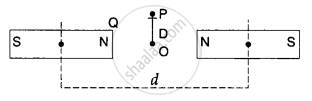
If a charged particle at rest experience no electromagnetic force
Essential difference between electrostatic shielding by a conducting shell and magnetostatic shielding is due to ______.
- electrostatic field lines can end on charges and conductors have free charges.
- lines of B can also end but conductors cannot end them.
- lines of B cannot end on any material and perfect shielding is not possible.
- shells of high permeability materials can be used to divert lines of B from the interior region.
Magnetic susceptibility for a paramagnetic and diamagnetic materials is respectively ______.
Explain the Domain theory in brief.
Explain the meaning of the following statement:
Curie temperature for soft iron is 770°C.
What is the susceptibility of diamagnetic substances?
How do ferromagnetic substances respond to a magnetic field?
Which list contains only examples of paramagnetic substances?
What causes the magnetic behaviour of ferromagnetic substances?
