Advertisements
Advertisements
प्रश्न
Distinguish between diamagnetic and paramagnetic substances.
Advertisements
उत्तर
| Sr. No. | Diamagnetic substance | Paramagnetic substance |
| 1. | In an external magnetic field, a substance gets weakly magnetised in the direction opposite to that of the field. | In an external magnetic field, a paramagnetic substance gets weakly magnetised in the same direction as that of the field. |
| 2. | When placed in a non-uniform magnetic field, it tends to move from the stronger to the weaker part of the field. | When placed in a non-uniform magnetic field, it tends to move from the weaker to the stronger part of the field. |
| 3. | It is weakly repelled by a magnet. | It is weakly attracted by a magnet. |
| 4. | Magnetic moment of every atom of a diamagnetic substance is zero. | Every atom of a paramagnetic substance is a magnetic dipole having a certain resultant magnetic moment. |
| 5. | When a rod of diamagnetic substance is suspended in a uniform magnetic field, it comes to rest with its length perpendicular to the direction of the field. | When a rod of paramagnetic substance is suspended in a uniform magnetic field, it comes to rest with its length parallel to the direction of the field. |
| 6. | There is no effect of temperature on diamagnetic substance. | There is effect of temperature on paramagnetic substance. |
APPEARS IN
संबंधित प्रश्न
Distinguish between ‘paramagnetic’ and ‘ferromagnetic’ substances.
Give any ‘two’ points of differences between diamagnetic and ferromagnetic substances.
In what way is the behaviour of a diamagnetic material different from that of a paramagnetic, when kept in an external magnetic field?
Out of the two magnetic materials, 'A' has relative permeability slightly greater than unity while 'B' has less than unity. Identify the nature of the materials 'A' and 'B'. Will their susceptibilities be positive or negative?
Explain Curie’s law for a paramagnetic substance.
Which of the following substances are diamagnetic?
Bi, Al, Na, Cu, Ca and Ni
The susceptibility of a magnetic material is − 2.6 × 10⁻⁵. Identify the type of magnetic material and state its two properties.
The relative magnetic permeability of a magnetic material is 800. Identify the nature of magnetic material and state its two properties.
Choose the correct option:
A magnetising field of 360 Am−1 produces a magnetic flux density (B) = 0.6T in a ferromagnetic material. What is its permeability in Tm A−1?
What happens to a ferromagnetic material when its temperature increases above curie temperature?
Answer in brief.
Discuss the Curie law for paramagnetic material.
A paramagnetic gas has 2.0 × 1026 atoms/m with atomic magnetic dipole moment of 1.5 × 10⁻²³ A m2 each. The gas is at 27°C.
- Find the maximum magnetization intensity of this sample.
- If the gas in this problem is kept in a uniform magnetic field of 3 T, is it possible to achieve saturation magnetization? Why?
Two identical bar magnets each of magnetic moment M, separated by some distance are kept perpendicular to each other. The magnetic induction at a point at the same distance d from the centre of magnets, is (µ0 = permeability of free space)
A domain in a ferromagnetic substance is in the form of a cube of side 1 µm. If it contains 8 × 10¹⁰ atoms and each atomic dipole has a dipole moment of 9 × 10-24 Am2 then the magnetisation of the domain is ______.
For a paramagnetic substance, the magnetic susceptibility is ______.
All atoms of a magnetic substance have a resultant magnetic moment even in absence of external magnetic field. The substance is ______.
There are three needles 'N1', 'N2' and 'N3' made of a ferromagnetic, a paramagnetic and a diamagnetic substance respectively. When a magnet is brought close to them, then it will ____________.
The magnetic property of magnetic substance is associated with ____________.
A short bar magnet has a magnetic moment of 0.48 J T−1. Give the direction and magnitude of the magnetic field produced by the magnet at a distance of 10 cm from the centre of the magnet on
- the axis,
- the equatorial lines (normal bisector) of the magnet.
Which graph shows the variation of magnetic susceptibility (`chi`) with magnetizing field (H) for a paramagnetic substance?
Why does a paramagnetic sample display greater magnetisation (for the same magnetising field) when cooled?
A certain region of space is to be shielded from magnetic fields. Suggest a method.
Assertion: The ferromagnetic substance do not obey Curie’s law.
Reason: At Curie point a ferromagnetic substance start behaving as a paramagnetic substance.
Assertion: A paramagnetic sample display greater magnetisation (for the same magnetic field) when cooled.
Reason: The magnetisation does not depend on temperature.
Metals getting magnetised by orientation of atomic magnetic moments in external magnetic field are called ______.
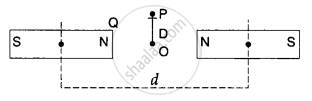
Two identical bar magnets are fixed with their centres at a distance d apart. A stationary charge Q is placed at P in between the gap of the two magnets at a distance D from the centre O as shown in the figure. The force on the charge Q is ______.
The magnetic susceptibility for diamagnetic materials is ______.
When a ferromagnetic material is created above its curie temperature
Earth's magnetic field analyses has a horizontal component except at:-
A hydrogen atom is paramagnetic. A hydrogen molecule is
S is the surface of a lump of magnetic material.
- Lines of B are necessarily continuous across S.
- Some lines of B must be discontinuous across S.
- Lines of H are necessarily continuous across S.
- Lines of H cannot all be continuous across S.
From molecular view point, discuss the temperature dependence of susceptibility for diamagnetism, paramagnetism and ferromagnetism.
A uniform magnetic field gets modified as shown in figure when two specimens A and B are placed in it.
 |
 |
| (a) | (b) |
- Identify the specimen A and B.
- How is the magnetic susceptibility of specimen A different from that of specimen B?
Magnetic susceptibility for a paramagnetic and diamagnetic materials is respectively ______.
The relative magnetic permeability of a substance X is slightly less than unity and that of substance Y is slightly more than unity, then ______.
What is magnetic hysterisis?
Explain ferromagnetism on the basis of the domain theory.
Explain the Domain theory in brief.
Explain the meaning of the following statement:
Curie temperature for soft iron is 770°C.
Which substances are strongly magnetised in the direction of the magnetising field?
On what basis are materials broadly classified into diamagnetic, paramagnetic, and ferromagnetic groups?
What is the susceptibility of diamagnetic substances?
What is the susceptibility of paramagnetic substances?
Which list contains only examples of paramagnetic substances?
Which mathematical relation expresses Curie's Law for paramagnetic substances?
What happens to paramagnetic substances on cooling at the Curie temperature?
What causes the magnetic behaviour of ferromagnetic substances?
How are the tiny domains oriented in an unmagnetised ferromagnetic specimen?
