Advertisements
Advertisements
प्रश्न
Explain qualitatively on the basis of domain picture the irreversibility in the magnetisation curve of a ferromagnet.
Advertisements
उत्तर
The hysteresis curve (B-H curve) of a ferromagnetic material is shown in the following figure.
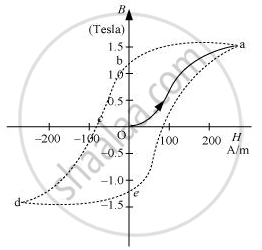
It can be observed from the given curve that magnetisation persists even when the external field is removed. This reflects the irreversibility of a ferromagnet.
APPEARS IN
संबंधित प्रश्न
Give any ‘two’ points of differences between diamagnetic and ferromagnetic substances.
Distinguish between diamagnetic and paramagnetic substances.
A meter gauge train is heading north with speed 54 km/hr in earth's magnetic field 3 x 10⁻⁴T. The e.m.f. induced across the axle joining the wheels is ..........
(a) 0.45 mV
(b) 4.5 mV
(c) 45 mV
(d) 450 m V
Two substances A and B have their relative permeability slightly greater and slightly less than 1 respectively. What do you conclude about A and B as far as their magnetic materials are concerned?
The susceptibility of a magnetic material is positive and small. The material is ______.
A domain in a ferromagnetic substance is in the form of a cube of side length 1 µm. If it contains 6 x 10¹⁰ atoms and each atomic dipole has a dipole moment of 7 x 10-24 Am2, then magnetization of the domain is ____________.
A short bar magnet has a magnetic moment of 0.48 J T−1. Give the direction and magnitude of the magnetic field produced by the magnet at a distance of 10 cm from the centre of the magnet on
- the axis,
- the equatorial lines (normal bisector) of the magnet.
Why is diamagnetism, in contrast, almost independent of temperature?
The magnetic susceptibility for diamagnetic materials is ______.
A long solenoid has 1000 turns per metre and carries a current of 1 A. It has a soft iron core of µr = 1000. The core is heated beyond the Curie temperature, Tc.
- The H field in the solenoid is (nearly) unchanged but the B field decreases drastically.
- The H and B fields in the solenoid are nearly unchanged.
- The magnetisation in the core reverses direction.
- The magnetisation in the core diminishes by a factor of about 108.
Magnetic susceptibility for a paramagnetic and diamagnetic materials is respectively ______.
- Assertion (A): Diamagnetic substances exhibit magnetism.
- Reason (R): Diamagnetic materials do not have a permanent magnetic dipole moment.
Which of the following has a permeability less than that of free space?
Match List-I with List-II.
| List-I (Material) | List-II (Susceptibility) | ||
| A. | Diamagnetic | I. | χ = 0 |
| B. | Ferromagnetic | II. | 0 > χ ≥ −1 |
| C. | Paramagnetic | III. | χ >> 1 |
| D. | Non-magnetic | IV. | 0 < χ < ε |
Choose the correct answer from the options given below:
Which substances are strongly magnetised in the direction of the magnetising field?
How do paramagnetic substances respond to a magnetic field?
Which list contains only examples of ferromagnetic substances?
What happens to paramagnetic substances on cooling at the Curie temperature?
