Advertisements
Advertisements
प्रश्न
Explain qualitatively on the basis of domain picture the irreversibility in the magnetisation curve of a ferromagnet.
Advertisements
उत्तर
The hysteresis curve (B-H curve) of a ferromagnetic material is shown in the following figure.
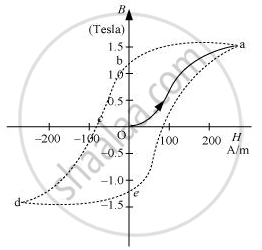
It can be observed from the given curve that magnetisation persists even when the external field is removed. This reflects the irreversibility of a ferromagnet.
APPEARS IN
संबंधित प्रश्न
In what way is the behaviour of a diamagnetic material different from that of a paramagnetic, when kept in an external magnetic field?
Show diagrammatically the behaviour of magnetic field lines in the presence of (i) paramagnetic and (ii) diamagnetic substances. How does one explain this distinguishing feature?
The susceptibility of a magnetic material is 0·9853. Identify the type of magnetic material. Draw the modification of the field pattern on keeping a piece of this material in a uniform magnetic field.
Which of the following substances are diamagnetic?
Bi, Al, Na, Cu, Ca and Ni
The susceptibility of a magnetic material is − 2.6 × 10⁻⁵. Identify the type of magnetic material and state its two properties.
Answer in brief.
Discuss the Curie law for paramagnetic material.
The susceptibility of a magnetic material is positive and small. The material is ______.
A sphere of gold when brought towards a powerful magnet experiences ____________.
A domain in a ferromagnetic substance is in the form of a cube of side length 1 µm. If it contains 6 x 10¹⁰ atoms and each atomic dipole has a dipole moment of 7 x 10-24 Am2, then magnetization of the domain is ____________.
S is the surface of a lump of magnetic material.
- Lines of B are necessarily continuous across S.
- Some lines of B must be discontinuous across S.
- Lines of H are necessarily continuous across S.
- Lines of H cannot all be continuous across S.
A long solenoid has 1000 turns per metre and carries a current of 1 A. It has a soft iron core of µr = 1000. The core is heated beyond the Curie temperature, Tc.
- The H field in the solenoid is (nearly) unchanged but the B field decreases drastically.
- The H and B fields in the solenoid are nearly unchanged.
- The magnetisation in the core reverses direction.
- The magnetisation in the core diminishes by a factor of about 108.
A permanent magnet in the shape of a thin cylinder of length 10 cm has M = 106 A/m. Calculate the magnetisation current IM.
Which substances are feebly magnetised in the direction of the magnetising field?
How do paramagnetic substances respond to a magnetic field?
How do ferromagnetic substances respond to a magnetic field?
Which mathematical relation expresses Weiss Law for ferromagnetic substances above the Curie temperature?
In the small-arrows analogy for ferromagnets, when does the total effect become strong?
