Advertisements
Advertisements
प्रश्न
A short bar magnet has a magnetic moment of 0.48 J T−1. Give the direction and magnitude of the magnetic field produced by the magnet at a distance of 10 cm from the centre of the magnet on
- the axis,
- the equatorial lines (normal bisector) of the magnet.
Advertisements
उत्तर
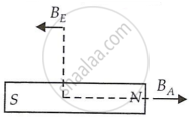
Given: Magnetic moment of the bar magnet, M = 0.48 J T−1
Distance, d = 10 cm = 0.1 m
(a) The magnetic field at a distance d from the centre of the magnet on the axis is given by the relation:
B = `μ_0/(4pi) (2M)/d^3`
Where,
μ0 = Permeability of free space = 4π × 10−7 T mA−1
∴ B = `(4pi xx 10^-7 xx 2 xx 0.48)/(4pi xx (0.1)^3)`
= 0.96 × 10⁻⁴ T
= 0.96 G
The magnetic field is along the S-N direction.
(b) The magnetic field at a distance of 10 cm (i.e., d = 0.1 m) on the equatorial line of the magnet is given as:
B = `(μ_0 xx M)/(4pi xx d^3)`
= `(4pi xx 10^-7 xx 0.48)/(4pi (0.1)^3)`
= 0.48 G
The magnetic field is along the N-S direction.
संबंधित प्रश्न
The susceptibility of magnesium at 200 K is 1.8 x 10⁻⁵. At what temperature will the susceptibility decrease by 6 x 10⁻⁶?
Distinguish between diamagnetic and paramagnetic substances.
There are three needles 'N1', 'N2' and 'N3' made of a ferromagnetic, a paramagnetic and a diamagnetic substance respectively. When a magnet is brought close to them, then it will ____________.
The product of magnetic susceptibility (`chi`) and absolute temperature (T) is constant for a ____________.
Above the curie temperature the susceptibility of ferromagnetic substance varies ____________.
A sphere of gold when brought towards a powerful magnet experiences ____________.
What kind of ferromagnetic material is used for coating magnetic tapes in a cassette player, or for building ‘memory stores’ in a modern computer?
A certain region of space is to be shielded from magnetic fields. Suggest a method.
Assertion: A paramagnetic sample display greater magnetisation (for the same magnetic field) when cooled.
Reason: The magnetisation does not depend on temperature.
Earth's magnetic field analyses has a horizontal component except at:-
If a charged particle at rest experience no electromagnetic force
A paramagnetic sample shows a net magnetisation of 8 Am–1 when placed in an external magnetic field of 0.6 T at a temperature of 4 K. When the same sample is placed in an external magnetic field of 0.2 T at a temperature of 16 K, the magnetisation will be ______.
Explain the origin of paramagnetism on the basis of atomic structure.
Which substances are feebly magnetised in the direction of the magnetising field?
What is the susceptibility of diamagnetic substances?
How do ferromagnetic substances respond to a magnetic field?
Which mathematical relation expresses Weiss Law for ferromagnetic substances above the Curie temperature?
How are the tiny domains oriented in an unmagnetised ferromagnetic specimen?
