Advertisements
Advertisements
प्रश्न
A short bar magnet placed in a horizontal plane has its axis aligned along the magnetic north-south direction. Null points are found on the axis of the magnet at 14 cm from the centre of the magnet. The earth’s magnetic field at the place is 0.36 G and the angle of dip is zero. What is the total magnetic field on the normal bisector of the magnet at the same distance as the null point (i.e., 14 cm) from the centre of the magnet? (At null points, field due to a magnet is equal and opposite to the horizontal component of earth’s magnetic field.)
Advertisements
उत्तर
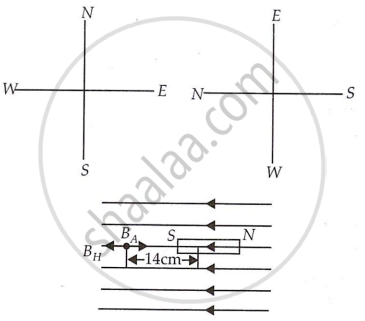
Earth’s magnetic field at the given place, H = 0.36 G
The magnetic field at a distance d, on the axis of the magnet is given as:
`"B"_1 = μ_0/(4pi) (2"M")/"d"^3 ="H"` ............(i)
Where,
μ0 = Permeability of free space
M = Magnetic moment
The magnetic field at the same distance d, on the equatorial line of the magnet is given as:
`"B"_2 = (μ_0"M")/(4pi"d"^3) = "H"/2` ...........[Using equation (i)]
Total magnetic field, B = B1 + B2
= `"H" + "H"/2`
= 0.36 + 0.18
= 0.54 G
Hence, the magnetic field is 0.54 G in the direction of the earth’s magnetic field.
APPEARS IN
संबंधित प्रश्न
The horizontal component of the earth’s magnetic field at a place is B and angle of dip is 60°. What is the value of vertical component of earth’s magnetic field at equator?
Can the earth's magnetic field be vertical at a place? What will happen to a freely suspended magnet at such a place? What is the value of dip here?
To keep valuable instruments away from the earth's magnetic field, they are enclosed in iron boxes. Explain.
State Tangent Law in magnetism.
Answer the following question regarding earth’s magnetism:
The earth’s field, it is claimed, roughly approximates the field due to a dipole of magnetic moment 8 × 10²² J T−1 located at its centre. Check the order of magnitude of this number in some way.
Answer the following question regarding earth’s magnetism:
Geologists claim that besides the main magnetic N-S poles, there are several local poles on the earth’s surface oriented in different directions. How is such a thing possible at all?
The earth’s magnetic field varies from point to point in space. Does it also change with time? If so, on what time scale does it change appreciably?
The earth may have even reversed the direction of its field several times during its history of 4 to 5 billion years. How can geologists know about the earth’s field in such distant past?
A telephone cable at a place has four long straight horizontal wires carrying a current of 1.0 A in the same direction east to west. The earth’s magnetic field at the place is 0.39 G, and the angle of dip is 35°. The magnetic declination is nearly zero. What are the resultant magnetic fields at points 4.0 cm below the cable?
A compass needle free to turn in a horizontal plane is placed at the centre of circular coil of 30 turns and radius 12 cm. The coil is in a vertical plane making an angle of 45° with the magnetic meridian. When the current in the coil is 0.35 A, the needle points west to east.
(a) Determine the horizontal component of the earth’s magnetic field at the location.
(b) The current in the coil is reversed, and the coil is rotated about its vertical axis by an angle of 90° in the anticlockwise sense looking from above. Predict the direction of the needle. Take the magnetic declination at the places to be zero.
Which of the following is responsible for the earth’s magnetic field?
The angle of dip at a certain place where the horizontal and vertical components of the earth’s magnetic field are equal is ______.
At a given place on earth’s surface the horizontal component of earth’s magnetic field is 2 × 10³-5 T and resultant magnetic field is 4 × 10³-5 T. The angle of dip at this place is ______.
A satellite S is moving in an elliptical orbit around the earth. The mass of the satellite is very small compared to the mass of the earth. Then,
