Advertisements
Advertisements
प्रश्न
A short bar magnet has a magnetic moment of 0.48 J T−1. Give the direction and magnitude of the magnetic field produced by the magnet at a distance of 10 cm from the centre of the magnet on
- the axis,
- the equatorial lines (normal bisector) of the magnet.
Advertisements
उत्तर
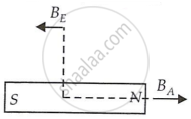
Given: Magnetic moment of the bar magnet, M = 0.48 J T−1
Distance, d = 10 cm = 0.1 m
(a) The magnetic field at a distance d from the centre of the magnet on the axis is given by the relation:
B = `μ_0/(4pi) (2M)/d^3`
Where,
μ0 = Permeability of free space = 4π × 10−7 T mA−1
∴ B = `(4pi xx 10^-7 xx 2 xx 0.48)/(4pi xx (0.1)^3)`
= 0.96 × 10⁻⁴ T
= 0.96 G
The magnetic field is along the S-N direction.
(b) The magnetic field at a distance of 10 cm (i.e., d = 0.1 m) on the equatorial line of the magnet is given as:
B = `(μ_0 xx M)/(4pi xx d^3)`
= `(4pi xx 10^-7 xx 0.48)/(4pi (0.1)^3)`
= 0.48 G
The magnetic field is along the N-S direction.
संबंधित प्रश्न
The susceptibility of magnesium at 200 K is 1.8 x 10⁻⁵. At what temperature will the susceptibility decrease by 6 x 10⁻⁶?
Explain Curie’s law for a paramagnetic substance.
A tangent galvanometer shows a deflection of 45° when 10 mA of current is passed through it. If the horizontal component of the earth's magnetic field is `B_H = 3.6 xx 10^-5 "T"` and radius of the coil is 10 cm, find the number of turns in the coil.
Answer the following question.
Write three points of differences between para-, dia- and ferromagnetic materials, giving one example for each.
What happens to a ferromagnetic material when its temperature increases above curie temperature?
Magnetization of the sample is ______.
A small quantity of paramagnetic liquid is taken in a watch - glass and kept on two dissimilar magnetic poles. The liquid ____________.
Which graph shows the variation of magnetic susceptibility (`chi`) with magnetizing field (H) for a paramagnetic substance?
Why is diamagnetism, in contrast, almost independent of temperature?
A Rowland ring of mean radius 15 cm has 3500 turns of wire wound on a ferromagnetic core of relative permeability 800. What is the magnetic field B in the core for a magnetising current of 1.2 A?
A hydrogen atom is paramagnetic. A hydrogen molecule is
Most of the substance show which of the magnetic property:-
The universal property of all substances is ______.
A long solenoid has 1000 turns per metre and carries a current of 1 A. It has a soft iron core of µr = 1000. The core is heated beyond the Curie temperature, Tc.
- The H field in the solenoid is (nearly) unchanged but the B field decreases drastically.
- The H and B fields in the solenoid are nearly unchanged.
- The magnetisation in the core reverses direction.
- The magnetisation in the core diminishes by a factor of about 108.
If the magnetizing field on a ferromagnetic material is increased, its permeability ______.
An ammeter of resistance R gives a full-scale deflection when a current of 2 A passes through it. If it is measured with a maximum current of 10 A, the required shunt is ______.
Which of the following has a permeability less than that of free space?
Explain the origin of paramagnetism on the basis of atomic structure.
