Advertisements
Advertisements
प्रश्न
A short bar magnet has a magnetic moment of 0.48 J T−1. Give the direction and magnitude of the magnetic field produced by the magnet at a distance of 10 cm from the centre of the magnet on
- the axis,
- the equatorial lines (normal bisector) of the magnet.
Advertisements
उत्तर
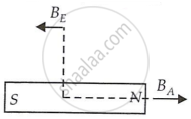
Given: Magnetic moment of the bar magnet, M = 0.48 J T−1
Distance, d = 10 cm = 0.1 m
(a) The magnetic field at a distance d from the centre of the magnet on the axis is given by the relation:
B = `μ_0/(4pi) (2M)/d^3`
Where,
μ0 = Permeability of free space = 4π × 10−7 T mA−1
∴ B = `(4pi xx 10^-7 xx 2 xx 0.48)/(4pi xx (0.1)^3)`
= 0.96 × 10⁻⁴ T
= 0.96 G
The magnetic field is along the S-N direction.
(b) The magnetic field at a distance of 10 cm (i.e., d = 0.1 m) on the equatorial line of the magnet is given as:
B = `(μ_0 xx M)/(4pi xx d^3)`
= `(4pi xx 10^-7 xx 0.48)/(4pi (0.1)^3)`
= 0.48 G
The magnetic field is along the N-S direction.
संबंधित प्रश्न
Out of the two magnetic materials, 'A' has relative permeability slightly greater than unity while 'B' has less than unity. Identify the nature of the materials 'A' and 'B'. Will their susceptibilities be positive or negative?
Show diagrammatically the behaviour of magnetic field lines in the presence of (i) paramagnetic and (ii) diamagnetic substances. How does one explain this distinguishing feature?
Which of the following substances are para-magnetic?
Bi, Al, Cu, Ca, Pb, Ni
Draw magnetic field line when a (i) diamagnetic, (ii) paramagnetic substance is placed in an external magnetic field. Which magnetic property distinguishes this behaviour of the field line due to the substances?
Choose the correct option:
A magnetising field of 360 Am−1 produces a magnetic flux density (B) = 0.6T in a ferromagnetic material. What is its permeability in Tm A−1?
A paramagnetic gas has 2.0 × 1026 atoms/m with atomic magnetic dipole moment of 1.5 × 10⁻²³ A m2 each. The gas is at 27°C.
- Find the maximum magnetization intensity of this sample.
- If the gas in this problem is kept in a uniform magnetic field of 3 T, is it possible to achieve saturation magnetization? Why?
Magnetization of the sample is ______.
The product of magnetic susceptibility (`chi`) and absolute temperature (T) is constant for a ____________.
What kind of ferromagnetic material is used for coating magnetic tapes in a cassette player, or for building ‘memory stores’ in a modern computer?
Nickel shows ferromagnetic property at room temperature. If the temperature is increased beyond curie temperature, then it will show ______.
According to the Atomic theory, on heating a magnet, the thermal energy of the elementary magnet ______
Explain quantitatively the order of magnitude difference between the diamagnetic susceptibility of N2 (~5 × 10⁻⁹) (at STP) and Cu (~10–5).
From molecular view point, discuss the temperature dependence of susceptibility for diamagnetism, paramagnetism and ferromagnetism.
If the magnetizing field on a ferromagnetic material is increased, its permeability ______.
Which substances are feebly magnetised in the direction of the magnetising field?
Which substances are strongly magnetised in the direction of the magnetising field?
What is the susceptibility of paramagnetic substances?
Which mathematical relation expresses Weiss Law for ferromagnetic substances above the Curie temperature?
What causes the magnetic behaviour of ferromagnetic substances?
