Advertisements
Advertisements
प्रश्न
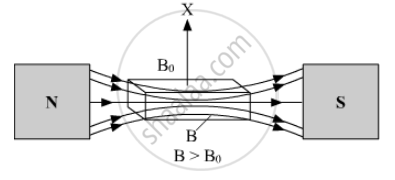
The susceptibility of a magnetic material is 0·9853. Identify the type of magnetic material. Draw the modification of the field pattern on keeping a piece of this material in a uniform magnetic field.
Advertisements
उत्तर
As we know that susceptibility of a paramagnetic substance is positive but small. Hence, the given magnetic material is paramagnetic in nature.
When a specimen of a paramagnetic substance is placed in a magnetising field, the magnetic field lines prefer to pass through the specimen rather than through air. Thus, magnetic induction B inside the sample is more than the magnetic induction B0 outside the sample.
APPEARS IN
संबंधित प्रश्न
Out of the two magnetic materials, 'A' has relative permeability slightly greater than unity while 'B' has less than unity. Identify the nature of the materials 'A' and 'B'. Will their susceptibilities be positive or negative?
Show diagrammatically the behaviour of magnetic field lines in the presence of (i) paramagnetic and (ii) diamagnetic substances. How does one explain this distinguishing feature?
Distinguish between diamagnetic and paramagnetic substances.
The magnetic susceptibility of annealed iron at saturation is 4224. Find the permeability of
annealed iron at saturation. (μ0 = 4Π × 10−7 SI unit)
Two substances A and B have their relative permeability slightly greater and slightly less than 1 respectively. What do you conclude about A and B as far as their magnetic materials are concerned?
What kind of ferromagnetic material is used for coating magnetic tapes in a cassette player, or for building ‘memory stores’ in a modern computer?
When a ferromagnetic material is created above its curie temperature
Magnetic susceptibility of a diamagnetic substance ______.
Which mathematical relation expresses Weiss Law for ferromagnetic substances above the Curie temperature?
How are the tiny domains oriented in an unmagnetised ferromagnetic specimen?
