Advertisements
Advertisements
प्रश्न
A rod of magnetic material of cross-section 0.25 cm2 is placed in a magnetizing field of intensity 4000 A/m-1. The magnetic flux passing through the rod is 25 × 10-6 Wb. Find out
(a) relative permeability
(b) magnetic susceptibility and
(c) magnetisation of the rod.
Advertisements
उत्तर
Given: A = 0.25 cm2 = 25 × 10-6 m2
H = 4000 A m-1, Φ = 25 × 10-6 Wb
Magnetic induction is
B = `phi/"A"`
`= (25 xx 10^-6)/(25 xx 10^-6)`
= 1 Wb/m2
(a) B = μ0μrH
∴ The relative permeability of the material,
`mu_"r" = "B"/(mu_0"H")`
`= 1/(4 xx 3.142 xx 10^-7 xx 4000)`
`= 10000/50.272`
= 198.91 = 199
(b) `mu_"r" = 1 + chi_"m"`
∴ The magnetic susceptibility of the material,
`chi_"m" = mu_"r" - 1`
= 199 - 1
= 198
(c) `chi_"m" = "M"_"z"/"H"`
The magnetization of the rod,
`"M"_"z" = chi_"m""H" = 198 xx 4000 = 7.92 xx 10^5`A/m
APPEARS IN
संबंधित प्रश्न
Give any ‘two’ points of differences between diamagnetic and ferromagnetic substances.
The susceptibility of magnesium at 200 K is 1.8 x 10⁻⁵. At what temperature will the susceptibility decrease by 6 x 10⁻⁶?
Out of the two magnetic materials, 'A' has relative permeability slightly greater than unity while 'B' has less than unity. Identify the nature of the materials 'A' and 'B'. Will their susceptibilities be positive or negative?
Distinguish between diamagnetic and paramagnetic substances.
The magnetic susceptibility of annealed iron at saturation is 4224. Find the permeability of
annealed iron at saturation. (μ0 = 4Π × 10−7 SI unit)
The susceptibility of a magnetic material is 0·9853. Identify the type of magnetic material. Draw the modification of the field pattern on keeping a piece of this material in a uniform magnetic field.
Explain Curie’s law for a paramagnetic substance.
A tangent galvanometer shows a deflection of 45° when 10 mA of current is passed through it. If the horizontal component of the earth's magnetic field is `B_H = 3.6 xx 10^-5 "T"` and radius of the coil is 10 cm, find the number of turns in the coil.
Two substances A and B have their relative permeability slightly greater and slightly less than 1 respectively. What do you conclude about A and B as far as their magnetic materials are concerned?
Identify the following magnetic materials :
Choose the correct option:
A rectangular magnet suspended freely has a period of oscillation equal to T. Now it is broken into two equal halves (each having half of the original length) and one piece is made to oscillate freely. Its period of oscillation is T′, the ratio of T′/T is ______.
Choose the correct option:
A magnetising field of 360 Am−1 produces a magnetic flux density (B) = 0.6T in a ferromagnetic material. What is its permeability in Tm A−1?
Answer in brief.
Discuss the Curie law for paramagnetic material.
The susceptibility of a paramagnetic material is χ at 27° C. At what temperature its susceptibility be χ/3?
A domain in a ferromagnetic substance is in the form of a cube of side 1 µm. If it contains 8 × 10¹⁰ atoms and each atomic dipole has a dipole moment of 9 × 10-24 Am2 then the magnetisation of the domain is ______.
Magnetization of the sample is ______.
Magnetic material can be easily magnetized if magnetic susceptibility is ______.
Relative permittivity and permeability of a material are `epsilon_"r"` and `µ_"r"` respectively. Which of the following values of these quantities are allowed for a diamagnetic material?
Above the curie temperature the susceptibility of ferromagnetic substance varies ____________.
A small quantity of paramagnetic liquid is taken in a watch - glass and kept on two dissimilar magnetic poles. The liquid ____________.
A domain in a ferromagnetic substance is in the form of a cube of side length 1 µm. If it contains 6 x 10¹⁰ atoms and each atomic dipole has a dipole moment of 7 x 10-24 Am2, then magnetization of the domain is ____________.
A short bar magnet has a magnetic moment of 0.48 J T−1. Give the direction and magnitude of the magnetic field produced by the magnet at a distance of 10 cm from the centre of the magnet on
- the axis,
- the equatorial lines (normal bisector) of the magnet.
A certain region of space is to be shielded from magnetic fields. Suggest a method.
A Rowland ring of mean radius 15 cm has 3500 turns of wire wound on a ferromagnetic core of relative permeability 800. What is the magnetic field B in the core for a magnetising current of 1.2 A?
Which of the following property shows the property of ferromagnetic substances?
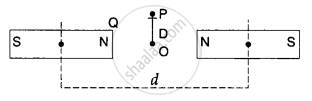
Two identical bar magnets are fixed with their centres at a distance d apart. A stationary charge Q is placed at P in between the gap of the two magnets at a distance D from the centre O as shown in the figure. The force on the charge Q is ______.
The magnetic susceptibility for diamagnetic materials is ______.
When a ferromagnetic material is created above its curie temperature
Earth's magnetic field analyses has a horizontal component except at:-
For a diamagnetic material
If a charged particle at rest experience no electromagnetic force
According to the Atomic theory, on heating a magnet, the thermal energy of the elementary magnet ______
S is the surface of a lump of magnetic material.
- Lines of B are necessarily continuous across S.
- Some lines of B must be discontinuous across S.
- Lines of H are necessarily continuous across S.
- Lines of H cannot all be continuous across S.
A long solenoid has 1000 turns per metre and carries a current of 1 A. It has a soft iron core of µr = 1000. The core is heated beyond the Curie temperature, Tc.
- The H field in the solenoid is (nearly) unchanged but the B field decreases drastically.
- The H and B fields in the solenoid are nearly unchanged.
- The magnetisation in the core reverses direction.
- The magnetisation in the core diminishes by a factor of about 108.
Essential difference between electrostatic shielding by a conducting shell and magnetostatic shielding is due to ______.
- electrostatic field lines can end on charges and conductors have free charges.
- lines of B can also end but conductors cannot end them.
- lines of B cannot end on any material and perfect shielding is not possible.
- shells of high permeability materials can be used to divert lines of B from the interior region.
Explain quantitatively the order of magnitude difference between the diamagnetic susceptibility of N2 (~5 × 10⁻⁹) (at STP) and Cu (~10–5).
A uniform magnetic field gets modified as shown in figure when two specimens A and B are placed in it.
 |
 |
| (a) | (b) |
- Identify the specimen A and B.
- How is the magnetic susceptibility of specimen A different from that of specimen B?
- Assertion (A): Diamagnetic substances exhibit magnetism.
- Reason (R): Diamagnetic materials do not have a permanent magnetic dipole moment.
Which of the following has a permeability less than that of free space?
The relative magnetic permeability of a substance X is slightly less than unity and that of substance Y is slightly more than unity, then ______.
Explain ferromagnetism on the basis of the domain theory.
Explain the origin of paramagnetism on the basis of atomic structure.
State the dimensions of magnetization.
Magnetic susceptibility of a diamagnetic substance ______.
