Advertisements
Advertisements
प्रश्न
A rod of magnetic material of cross-section 0.25 cm2 is placed in a magnetizing field of intensity 4000 A/m-1. The magnetic flux passing through the rod is 25 × 10-6 Wb. Find out
(a) relative permeability
(b) magnetic susceptibility and
(c) magnetisation of the rod.
Advertisements
उत्तर
Given: A = 0.25 cm2 = 25 × 10-6 m2
H = 4000 A m-1, Φ = 25 × 10-6 Wb
Magnetic induction is
B = `phi/"A"`
`= (25 xx 10^-6)/(25 xx 10^-6)`
= 1 Wb/m2
(a) B = μ0μrH
∴ The relative permeability of the material,
`mu_"r" = "B"/(mu_0"H")`
`= 1/(4 xx 3.142 xx 10^-7 xx 4000)`
`= 10000/50.272`
= 198.91 = 199
(b) `mu_"r" = 1 + chi_"m"`
∴ The magnetic susceptibility of the material,
`chi_"m" = mu_"r" - 1`
= 199 - 1
= 198
(c) `chi_"m" = "M"_"z"/"H"`
The magnetization of the rod,
`"M"_"z" = chi_"m""H" = 198 xx 4000 = 7.92 xx 10^5`A/m
APPEARS IN
संबंधित प्रश्न
Which of the following substances is ductile?
Give any ‘two’ points of differences between diamagnetic and ferromagnetic substances.
An iron rod of the area of cross-section 0.1m2 is subjected to a magnetizing field of 1000 A/m. Calculate the magnetic permeability of the iron rod. [Magnetic susceptibility of iron = 59.9, magnetic permeability of vacuum = 4π x 10-7 S. I. unit]
In what way is the behaviour of a diamagnetic material different from that of a paramagnetic, when kept in an external magnetic field?
Out of the two magnetic materials, 'A' has relative permeability slightly greater than unity while 'B' has less than unity. Identify the nature of the materials 'A' and 'B'. Will their susceptibilities be positive or negative?
Which of the following substances are diamagnetic?
Bi, Al, Na, Cu, Ca and Ni
The susceptibility of a magnetic material is − 2.6 × 10⁻⁵. Identify the type of magnetic material and state its two properties.
The magnetic susceptibility of platinum is 0.0001. It's relative permeability is:
Two substances A and B have their relative permeability slightly greater and slightly less than 1 respectively. What do you conclude about A and B as far as their magnetic materials are concerned?
Choose the correct option:
A rectangular magnet suspended freely has a period of oscillation equal to T. Now it is broken into two equal halves (each having half of the original length) and one piece is made to oscillate freely. Its period of oscillation is T′, the ratio of T′/T is ______.
Choose the correct option:
A magnetising field of 360 Am−1 produces a magnetic flux density (B) = 0.6T in a ferromagnetic material. What is its permeability in Tm A−1?
The susceptibility of a magnetic material is positive and small. The material is ______.
The magnetic susceptibility of a paramagnetic material at - 73 °C is 0.0075. Its value at -173 °C will be ______.
All atoms of a magnetic substance have a resultant magnetic moment even in absence of external magnetic field. The substance is ______.
Relative permittivity and permeability of a material are `epsilon_"r"` and `µ_"r"` respectively. Which of the following values of these quantities are allowed for a diamagnetic material?
There are three needles 'N1', 'N2' and 'N3' made of a ferromagnetic, a paramagnetic and a diamagnetic substance respectively. When a magnet is brought close to them, then it will ____________.
A small quantity of paramagnetic liquid is taken in a watch - glass and kept on two dissimilar magnetic poles. The liquid ____________.
A domain in a ferromagnetic substance is in the form of a cube of side length 1 µm. If it contains 6 x 10¹⁰ atoms and each atomic dipole has a dipole moment of 7 x 10-24 Am2, then magnetization of the domain is ____________.
Which graph shows the variation of magnetic susceptibility (`chi`) with magnetizing field (H) for a paramagnetic substance?
Is the permeability of a ferromagnetic material independent of the magnetic field? If not, is it more for lower or higher fields?
Magnetic field lines are always nearly normal to the surface of a ferromagnet at every point. (This fact is analogous to the static electric field lines being normal to the surface of a conductor at every point.) Why?
What kind of ferromagnetic material is used for coating magnetic tapes in a cassette player, or for building ‘memory stores’ in a modern computer?
Nickel shows ferromagnetic property at room temperature. If the temperature is increased beyond curie temperature, then it will show ______.
The given figure represents a material which is ______.

Assertion: The ferromagnetic substance do not obey Curie’s law.
Reason: At Curie point a ferromagnetic substance start behaving as a paramagnetic substance.
Assertion: A paramagnetic sample display greater magnetisation (for the same magnetic field) when cooled.
Reason: The magnetisation does not depend on temperature.
Metals getting magnetised by orientation of atomic magnetic moments in external magnetic field are called ______.
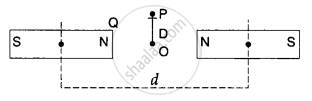
Two identical bar magnets are fixed with their centres at a distance d apart. A stationary charge Q is placed at P in between the gap of the two magnets at a distance D from the centre O as shown in the figure. The force on the charge Q is ______.
Earth's magnetic field analyses has a horizontal component except at:-
For a diamagnetic material
Essential difference between electrostatic shielding by a conducting shell and magnetostatic shielding is due to ______.
- electrostatic field lines can end on charges and conductors have free charges.
- lines of B can also end but conductors cannot end them.
- lines of B cannot end on any material and perfect shielding is not possible.
- shells of high permeability materials can be used to divert lines of B from the interior region.
From molecular view point, discuss the temperature dependence of susceptibility for diamagnetism, paramagnetism and ferromagnetism.
A uniform magnetic field gets modified as shown in figure when two specimens A and B are placed in it.
 |
 |
| (a) | (b) |
- Identify the specimen A and B.
- How is the magnetic susceptibility of specimen A different from that of specimen B?
Magnetic susceptibility for a paramagnetic and diamagnetic materials is respectively ______.
An ammeter of resistance R gives a full-scale deflection when a current of 2 A passes through it. If it is measured with a maximum current of 10 A, the required shunt is ______.
- Assertion (A): Diamagnetic substances exhibit magnetism.
- Reason (R): Diamagnetic materials do not have a permanent magnetic dipole moment.
Which of the following has a permeability less than that of free space?
Which of the following cannot modify an external magnetic field as shown in the figure?

The relative magnetic permeability of a substance X is slightly less than unity and that of substance Y is slightly more than unity, then ______.
Magnetic susceptibility of a diamagnetic substance ______.
Match List-I with List-II.
| List-I (Material) | List-II (Susceptibility) | ||
| A. | Diamagnetic | I. | χ = 0 |
| B. | Ferromagnetic | II. | 0 > χ ≥ −1 |
| C. | Paramagnetic | III. | χ >> 1 |
| D. | Non-magnetic | IV. | 0 < χ < ε |
Choose the correct answer from the options given below:
Which substances are strongly magnetised in the direction of the magnetising field?
On what basis are materials broadly classified into diamagnetic, paramagnetic, and ferromagnetic groups?
What is the susceptibility of diamagnetic substances?
How do diamagnetic substances respond to a magnetic field?
How do ferromagnetic substances respond to a magnetic field?
Which list contains only examples of paramagnetic substances?
How does the magnetic susceptibility of a paramagnetic material vary with its absolute temperature under Curie's Law?
What causes the magnetic behaviour of ferromagnetic substances?
