Advertisements
Advertisements
प्रश्न
Give any ‘two’ points of differences between diamagnetic and ferromagnetic substances.
Advertisements
उत्तर
| Diamagnetic Substance | Ferromagnetic Substance | ||
| 1 | Weakly repelled by a magnet | 1 | Strongly attracted by a magnet |
| 2 | When kept in a non-uniform magnetic field, it shows moderate tendency to move from stronger to the weaker part of the field. | 2 | When kept in a non-uniform magnetic field, it shows strong tendency to move from weaker to the stronger part of the field. |
APPEARS IN
संबंधित प्रश्न
Which of the following substances is ductile?
An iron rod of the area of cross-section 0.1m2 is subjected to a magnetizing field of 1000 A/m. Calculate the magnetic permeability of the iron rod. [Magnetic susceptibility of iron = 59.9, magnetic permeability of vacuum = 4π x 10-7 S. I. unit]
Distinguish between diamagnetic and paramagnetic substances.
Which of the following substances are para-magnetic?
Bi, Al, Cu, Ca, Pb, Ni
The relative magnetic permeability of a magnetic material is 800. Identify the nature of magnetic material and state its two properties.
The magnetic susceptibility of platinum is 0.0001. It's relative permeability is:
Two substances A and B have their relative permeability slightly greater and slightly less than 1 respectively. What do you conclude about A and B as far as their magnetic materials are concerned?
Answer the following question.
Write three points of differences between para-, dia- and ferromagnetic materials, giving one example for each.
Choose the correct option:
A rectangular magnet suspended freely has a period of oscillation equal to T. Now it is broken into two equal halves (each having half of the original length) and one piece is made to oscillate freely. Its period of oscillation is T′, the ratio of T′/T is ______.
Answer in brief.
Discuss the Curie law for paramagnetic material.
A domain in a ferromagnetic substance is in the form of a cube of side 1 µm. If it contains 8 × 10¹⁰ atoms and each atomic dipole has a dipole moment of 9 × 10-24 Am2 then the magnetisation of the domain is ______.
The susceptibility of a magnetic material is positive and small. The material is ______.
Magnetization of the sample is ______.
If a magnetic field is applied to a liquid in one arm of a narrow U-tube, the liquid level in that arm is lowered. The liquid in U-tube arm is ______.
The materials having negative magnetic susceptibility are ____________.
The magnetic property of magnetic substance is associated with ____________.
Above the curie temperature the susceptibility of ferromagnetic substance varies ____________.
A short bar magnet has a magnetic moment of 0.48 J T−1. Give the direction and magnitude of the magnetic field produced by the magnet at a distance of 10 cm from the centre of the magnet on
- the axis,
- the equatorial lines (normal bisector) of the magnet.
Why does a paramagnetic sample display greater magnetisation (for the same magnetising field) when cooled?
If a toroid uses bismuth for its core, will the field in the core be (slightly) greater or (slightly) less than when the core is empty?
Magnetic field lines are always nearly normal to the surface of a ferromagnet at every point. (This fact is analogous to the static electric field lines being normal to the surface of a conductor at every point.) Why?
Would the maximum possible magnetisation of a paramagnetic sample be of the same order of magnitude as the magnetisation of a ferromagnet?
A Rowland ring of mean radius 15 cm has 3500 turns of wire wound on a ferromagnetic core of relative permeability 800. What is the magnetic field B in the core for a magnetising current of 1.2 A?
The coercivity of a small magnet where the ferromagnet gets demagnetized is 3 × 10³ Am–1. The current required to be passed in a solenoid of length 10 cm and number of turns 100, so that the magnet gets demagnetized when inside the solenoid, is ______.
Assertion: A paramagnetic sample display greater magnetisation (for the same magnetic field) when cooled.
Reason: The magnetisation does not depend on temperature.
The magnetic susceptibility is negative for ______.
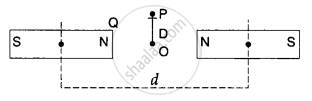
Two identical bar magnets are fixed with their centres at a distance d apart. A stationary charge Q is placed at P in between the gap of the two magnets at a distance D from the centre O as shown in the figure. The force on the charge Q is ______.
When a ferromagnetic material is created above its curie temperature
A hydrogen atom is paramagnetic. A hydrogen molecule is
Most of the substance show which of the magnetic property:-
If a charged particle at rest experience no electromagnetic force
A paramagnetic sample shows a net magnetisation of 8 Am–1 when placed in an external magnetic field of 0.6 T at a temperature of 4 K. When the same sample is placed in an external magnetic field of 0.2 T at a temperature of 16 K, the magnetisation will be ______.
A long solenoid has 1000 turns per metre and carries a current of 1 A. It has a soft iron core of µr = 1000. The core is heated beyond the Curie temperature, Tc.
- The H field in the solenoid is (nearly) unchanged but the B field decreases drastically.
- The H and B fields in the solenoid are nearly unchanged.
- The magnetisation in the core reverses direction.
- The magnetisation in the core diminishes by a factor of about 108.
A permanent magnet in the shape of a thin cylinder of length 10 cm has M = 106 A/m. Calculate the magnetisation current IM.
An ammeter of resistance R gives a full-scale deflection when a current of 2 A passes through it. If it is measured with a maximum current of 10 A, the required shunt is ______.
- Assertion (A): Diamagnetic substances exhibit magnetism.
- Reason (R): Diamagnetic materials do not have a permanent magnetic dipole moment.
Which of the following has a permeability less than that of free space?
Which of the following cannot modify an external magnetic field as shown in the figure?

Explain ferromagnetism on the basis of the domain theory.
On what basis are materials broadly classified into diamagnetic, paramagnetic, and ferromagnetic groups?
How do paramagnetic substances respond to a magnetic field?
Which list contains only examples of ferromagnetic substances?
Which mathematical relation expresses Curie's Law for paramagnetic substances?
What happens to paramagnetic substances on cooling at the Curie temperature?
How are the tiny domains oriented in an unmagnetised ferromagnetic specimen?
In the small-arrows analogy for ferromagnets, when does the total effect become strong?
