Advertisements
Advertisements
प्रश्न
Explain ferromagnetism on the basis of the domain theory.
Explain ferromagnetism with the help of suitable diagrams, using the concept of magnetic domain.
Advertisements
उत्तर १
Due mostly to the electrons' spin magnetic moments, ferromagnetic material atoms have a persistent non-zero magnetic dipole moment. Little areas known as domains make up a ferromagnetic substance, according to the domain hypothesis. An incredibly small area with a high concentration of atoms—roughly 1015 atoms, or the same number as ordinary iron—is called a domain. Even in the absence of an external magnetic field, the atomic magnetic moments of nearest-neighbour atoms within each domain interact strongly through exchange interaction, a phenomenon described by quantum mechanics. As a result, the atoms align themselves parallel to one another. That is, a domain becomes spontaneously magnetised to saturation. In an unsealed substance, on the other hand, the net magnetisation is zero due to the distinct domains' magnetisation orientations being so aligned.

Domains in a single crystal of iron The arrows indicate the direction and magnitude of the magnetization of each domain.
The specimen becomes more magnetised as a result of applying an external magnetic field. One of two methods is used to do this: either a favourably oriented domain expands at the expense of a less favourably oriented domain, or the magnetisation direction of an entire domain shifts to align with the external magnetic field. Favourably oriented domains increase in size by domain border displacement when a weak magnetic field is applied, as shown in Fig. (b). Figs. (c) and (d) show how domain rotation causes the domains to shift their magnetisation under strong fields. When domains line perfectly, as they do in Fig. (d), they combine to form a single, huge domain.
It might be energetically advantageous for a domain's direction of magnetisation to continue after the external field is eliminated. A persistent magnetic dipole moment is thus present in the specimen. The existence of permanent magnets is based on a phenomenon known as magnetic remanence.
उत्तर २
Ferromagnetism based on domain theory:
- Individual atoms in ferromagnetic materials are linked to significant magnetic moments.
- The magnetic moments of atoms close to each other interact and naturally line up in the same way over large areas known as domains.
- Each domain typically measures approximately 1 mm and comprises around 1011 atoms. So, each domain possesses a significant magnetic moment.
- Without an external magnetic field, these domains are arbitrarily oriented, resulting in a net magnetic moment of zero.

- When subjected to a magnetic field, all of the domains align with one another along the direction of the field being applied.
- Magnets aggressively attract ferromagnetic materials.
- The alignment of domains may occur in either of the two ways.
- By displacing the boundaries of domains.
- By rotation of domains.
APPEARS IN
संबंधित प्रश्न
Distinguish between ‘paramagnetic’ and ‘ferromagnetic’ substances.
Which of the following substances is ductile?
Give any ‘two’ points of differences between diamagnetic and ferromagnetic substances.
The susceptibility of magnesium at 200 K is 1.8 x 10⁻⁵. At what temperature will the susceptibility decrease by 6 x 10⁻⁶?
Out of the two magnetic materials, 'A' has relative permeability slightly greater than unity while 'B' has less than unity. Identify the nature of the materials 'A' and 'B'. Will their susceptibilities be positive or negative?
Distinguish between diamagnetic and paramagnetic substances.
Explain Curie’s law for a paramagnetic substance.
The relative magnetic permeability of a magnetic material is 800. Identify the nature of magnetic material and state its two properties.
Two substances A and B have their relative permeability slightly greater and slightly less than 1 respectively. What do you conclude about A and B as far as their magnetic materials are concerned?
Identify the following magnetic materials :
Which of the following statements is correct for diamagnetic materials?
Choose the correct option:
A magnetising field of 360 Am−1 produces a magnetic flux density (B) = 0.6T in a ferromagnetic material. What is its permeability in Tm A−1?
The susceptibility of a paramagnetic material is χ at 27° C. At what temperature its susceptibility be χ/3?
A rod of magnetic material of cross-section 0.25 cm2 is placed in a magnetizing field of intensity 4000 A/m-1. The magnetic flux passing through the rod is 25 × 10-6 Wb. Find out
(a) relative permeability
(b) magnetic susceptibility and
(c) magnetisation of the rod.
The susceptibility of a magnetic material is positive and small. The material is ______.
Magnetization of the sample is ______.
The magnetic property of magnetic substance is associated with ____________.
The earth’s field departs from its dipole shape substantially at large distances (greater than about 30,000 km). What agencies may be responsible for this distortion?
Why does a paramagnetic sample display greater magnetisation (for the same magnetising field) when cooled?
Why is diamagnetism, in contrast, almost independent of temperature?
If a toroid uses bismuth for its core, will the field in the core be (slightly) greater or (slightly) less than when the core is empty?
Is the permeability of a ferromagnetic material independent of the magnetic field? If not, is it more for lower or higher fields?
Explain qualitatively on the basis of domain picture the irreversibility in the magnetisation curve of a ferromagnet.
A certain region of space is to be shielded from magnetic fields. Suggest a method.
A Rowland ring of mean radius 15 cm has 3500 turns of wire wound on a ferromagnetic core of relative permeability 800. What is the magnetic field B in the core for a magnetising current of 1.2 A?
Nickel shows ferromagnetic property at room temperature. If the temperature is increased beyond curie temperature, then it will show ______.
The given figure represents a material which is ______.

The coercivity of a small magnet where the ferromagnet gets demagnetized is 3 × 10³ Am–1. The current required to be passed in a solenoid of length 10 cm and number of turns 100, so that the magnet gets demagnetized when inside the solenoid, is ______.
Metals getting magnetised by orientation of atomic magnetic moments in external magnetic field are called ______.
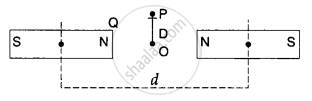
Two identical bar magnets are fixed with their centres at a distance d apart. A stationary charge Q is placed at P in between the gap of the two magnets at a distance D from the centre O as shown in the figure. The force on the charge Q is ______.
The magnetic susceptibility for diamagnetic materials is ______.
When a ferromagnetic material is created above its curie temperature
Earth's magnetic field analyses has a horizontal component except at:-
If a charged particle at rest experience no electromagnetic force
According to the Atomic theory, on heating a magnet, the thermal energy of the elementary magnet ______
S is the surface of a lump of magnetic material.
- Lines of B are necessarily continuous across S.
- Some lines of B must be discontinuous across S.
- Lines of H are necessarily continuous across S.
- Lines of H cannot all be continuous across S.
Essential difference between electrostatic shielding by a conducting shell and magnetostatic shielding is due to ______.
- electrostatic field lines can end on charges and conductors have free charges.
- lines of B can also end but conductors cannot end them.
- lines of B cannot end on any material and perfect shielding is not possible.
- shells of high permeability materials can be used to divert lines of B from the interior region.
From molecular view point, discuss the temperature dependence of susceptibility for diamagnetism, paramagnetism and ferromagnetism.
If the magnetizing field on a ferromagnetic material is increased, its permeability ______.
Magnetic susceptibility for a paramagnetic and diamagnetic materials is respectively ______.
- Assertion (A): Diamagnetic substances exhibit magnetism.
- Reason (R): Diamagnetic materials do not have a permanent magnetic dipole moment.
Explain the origin of paramagnetism on the basis of atomic structure.
Explain the Domain theory in brief.
What is the susceptibility of diamagnetic substances?
How do diamagnetic substances respond to a magnetic field?
Which list contains only examples of diamagnetic substances?
Which list contains only examples of paramagnetic substances?
Which list contains only examples of ferromagnetic substances?
How does the magnetic susceptibility of a paramagnetic material vary with its absolute temperature under Curie's Law?
What happens to paramagnetic substances on cooling at the Curie temperature?
What happens to ferromagnetic substances on heating beyond the Curie temperature?
What causes the magnetic behaviour of ferromagnetic substances?
How are the tiny domains oriented in an unmagnetised ferromagnetic specimen?
In the small-arrows analogy for ferromagnets, when does the total effect become strong?
