Advertisements
Advertisements
प्रश्न
The susceptibility of magnesium at 200 K is 1.8 x 10⁻⁵. At what temperature will the susceptibility decrease by 6 x 10⁻⁶?
Advertisements
उत्तर
Given,
T = 200K,
χ1 = 1.8 × 10⁻⁵
χ1 - χ2 = 6 × 10⁻⁶
To Find: Required temperature (T2)
Formula: χT=constatnt
Calculation :
χ1 - χ2 = 6 × 10⁻⁶
χ2 = 1.8×10⁻⁵ - 0.6×10⁻⁵
χ2 = 1.2 ×10⁻⁵
From formula,
∴χT = constant
χ1T1 = χ2T2
`T_2 =(chi_1T_1)/chi_2`
`T_2=(1.8xx10^-5xx200)/(1.2xx10^-5)`
`T_2 = 300K `
The required temperature is 300 K.
APPEARS IN
संबंधित प्रश्न
Distinguish between ‘paramagnetic’ and ‘ferromagnetic’ substances.
Give any ‘two’ points of differences between diamagnetic and ferromagnetic substances.
The magnetic susceptibility of annealed iron at saturation is 4224. Find the permeability of
annealed iron at saturation. (μ0 = 4Π × 10−7 SI unit)
Explain Curie’s law for a paramagnetic substance.
Which of the following substances are diamagnetic?
Bi, Al, Na, Cu, Ca and Ni
The relative magnetic permeability of a magnetic material is 800. Identify the nature of magnetic material and state its two properties.
Draw magnetic field line when a (i) diamagnetic, (ii) paramagnetic substance is placed in an external magnetic field. Which magnetic property distinguishes this behaviour of the field line due to the substances?
A tangent galvanometer shows a deflection of 45° when 10 mA of current is passed through it. If the horizontal component of the earth's magnetic field is `B_H = 3.6 xx 10^-5 "T"` and radius of the coil is 10 cm, find the number of turns in the coil.
Answer the following question.
Write three points of differences between para-, dia- and ferromagnetic materials, giving one example for each.
Which of the following statements is correct for diamagnetic materials?
Choose the correct option:
A magnetising field of 360 Am−1 produces a magnetic flux density (B) = 0.6T in a ferromagnetic material. What is its permeability in Tm A−1?
What happens to a ferromagnetic material when its temperature increases above curie temperature?
A paramagnetic gas has 2.0 × 1026 atoms/m with atomic magnetic dipole moment of 1.5 × 10⁻²³ A m2 each. The gas is at 27°C.
- Find the maximum magnetization intensity of this sample.
- If the gas in this problem is kept in a uniform magnetic field of 3 T, is it possible to achieve saturation magnetization? Why?
Two identical bar magnets each of magnetic moment M, separated by some distance are kept perpendicular to each other. The magnetic induction at a point at the same distance d from the centre of magnets, is (µ0 = permeability of free space)
A domain in a ferromagnetic substance is in the form of a cube of side 1 µm. If it contains 8 × 10¹⁰ atoms and each atomic dipole has a dipole moment of 9 × 10-24 Am2 then the magnetisation of the domain is ______.
For a paramagnetic substance, the magnetic susceptibility is ______.
All atoms of a magnetic substance have a resultant magnetic moment even in absence of external magnetic field. The substance is ______.
Magnetization of the sample is ______.
The materials having negative magnetic susceptibility are ____________.
The product of magnetic susceptibility (`chi`) and absolute temperature (T) is constant for a ____________.
Above the curie temperature the susceptibility of ferromagnetic substance varies ____________.
A short bar magnet has a magnetic moment of 0.48 J T−1. Give the direction and magnitude of the magnetic field produced by the magnet at a distance of 10 cm from the centre of the magnet on
- the axis,
- the equatorial lines (normal bisector) of the magnet.
Explain qualitatively on the basis of domain picture the irreversibility in the magnetisation curve of a ferromagnet.
What kind of ferromagnetic material is used for coating magnetic tapes in a cassette player, or for building ‘memory stores’ in a modern computer?
Assertion: The ferromagnetic substance do not obey Curie’s law.
Reason: At Curie point a ferromagnetic substance start behaving as a paramagnetic substance.
The coercivity of a small magnet where the ferromagnet gets demagnetized is 3 × 10³ Am–1. The current required to be passed in a solenoid of length 10 cm and number of turns 100, so that the magnet gets demagnetized when inside the solenoid, is ______.
Assertion: A paramagnetic sample display greater magnetisation (for the same magnetic field) when cooled.
Reason: The magnetisation does not depend on temperature.
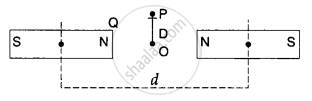
Two identical bar magnets are fixed with their centres at a distance d apart. A stationary charge Q is placed at P in between the gap of the two magnets at a distance D from the centre O as shown in the figure. The force on the charge Q is ______.
When a ferromagnetic material is created above its curie temperature
Earth's magnetic field analyses has a horizontal component except at:-
A hydrogen atom is paramagnetic. A hydrogen molecule is
If a charged particle at rest experience no electromagnetic force
The universal property of all substances is ______.
According to the Atomic theory, on heating a magnet, the thermal energy of the elementary magnet ______
Explain the origin of paramagnetism on the basis of atomic structure.
Explain the Domain theory in brief.
Explain the meaning of the following statement:
Curie temperature for soft iron is 770°C.
What is the susceptibility of diamagnetic substances?
How do diamagnetic substances respond to a magnetic field?
How do paramagnetic substances respond to a magnetic field?
How do ferromagnetic substances respond to a magnetic field?
Which list contains only examples of diamagnetic substances?
What happens to paramagnetic substances on cooling at the Curie temperature?
What happens to ferromagnetic substances on heating beyond the Curie temperature?
In the small-arrows analogy for ferromagnets, when does the total effect become strong?
