Advertisements
Advertisements
प्रश्न
A Rowland ring of mean radius 15 cm has 3500 turns of wire wound on a ferromagnetic core of relative permeability 800. What is the magnetic field B in the core for a magnetising current of 1.2 A?
Advertisements
उत्तर
Mean radius of a Rowland ring, r = 15 cm = 0.15 m
Number of turns on a ferromagnetic core, N = 3500
Relative permeability of the core material, μr = 800
Magnetising current, I = 1.2 A
The magnetic field is given by the relation:
B = `(μ_"r"μ_0"IN")/(2π"r")`
Where,
μ0 = Permeability of free space = 4π × 10−7 T mA−1
B = `(800 xx 4π xx 10^-7 xx 1.2 xx 3500)/(2π xx 0.15)`
= 4.48 T
Therefore, the magnetic field in the core is 4.48 T.
APPEARS IN
संबंधित प्रश्न
A tangent galvanometer shows a deflection of 45° when 10 mA of current is passed through it. If the horizontal component of the earth's magnetic field is `B_H = 3.6 xx 10^-5 "T"` and radius of the coil is 10 cm, find the number of turns in the coil.
Which of the following statements is correct for diamagnetic materials?
If a magnetic field is applied to a liquid in one arm of a narrow U-tube, the liquid level in that arm is lowered. The liquid in U-tube arm is ______.
Relative permittivity and permeability of a material are `epsilon_"r"` and `µ_"r"` respectively. Which of the following values of these quantities are allowed for a diamagnetic material?
The magnetic property of magnetic substance is associated with ____________.
A sphere of gold when brought towards a powerful magnet experiences ____________.
Magnetic field lines are always nearly normal to the surface of a ferromagnet at every point. (This fact is analogous to the static electric field lines being normal to the surface of a conductor at every point.) Why?
Would the maximum possible magnetisation of a paramagnetic sample be of the same order of magnitude as the magnetisation of a ferromagnet?
Nickel shows ferromagnetic property at room temperature. If the temperature is increased beyond curie temperature, then it will show ______.
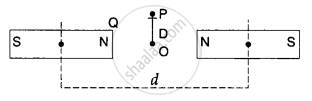
Two identical bar magnets are fixed with their centres at a distance d apart. A stationary charge Q is placed at P in between the gap of the two magnets at a distance D from the centre O as shown in the figure. The force on the charge Q is ______.
Earth's magnetic field analyses has a horizontal component except at:-
A hydrogen atom is paramagnetic. A hydrogen molecule is
A permanent magnet in the shape of a thin cylinder of length 10 cm has M = 106 A/m. Calculate the magnetisation current IM.
From molecular view point, discuss the temperature dependence of susceptibility for diamagnetism, paramagnetism and ferromagnetism.
Magnetic susceptibility for a paramagnetic and diamagnetic materials is respectively ______.
Explain the meaning of the following statement:
Curie temperature for soft iron is 770°C.
Match List-I with List-II.
| List-I (Material) | List-II (Susceptibility) | ||
| A. | Diamagnetic | I. | χ = 0 |
| B. | Ferromagnetic | II. | 0 > χ ≥ −1 |
| C. | Paramagnetic | III. | χ >> 1 |
| D. | Non-magnetic | IV. | 0 < χ < ε |
Choose the correct answer from the options given below:
What is the susceptibility of paramagnetic substances?
