Advertisements
Advertisements
प्रश्न
Explain quantitatively the order of magnitude difference between the diamagnetic susceptibility of N2 (~5 × 10⁻⁹) (at STP) and Cu (~10–5).
Advertisements
उत्तर
Magnetic susceptibility: It is the property of the substance which shows how easily a substance can be magnetised. It can also be defined as the ratio of intensity of magnetisation (I) in a substance to the magnetic intensity (H) applied to the substance, i.e., XM = I/H.
According to the problem, we have
Density of nitrogen `ρ_(N_2) = (28 g)/(22.4 L) = (28 g)/(22400 "cc")`
Also. density of copper `ρ_(C_u) = (8 g)/(22.4 L) = (8 g)/(22400 "cc")`
So, ratio of both densities
`(ρ_(N_2))/(ρ_(Cu)) = 28/22400 xx 1/8 = 16 xx 10^-4`
Also given `(chi_(N_2))/(chi_(Cu)) = (5 xx 10^-9)/10^-5 = 5 xx 10^-4`
`(chi_m)_("Fero") ≈ 10^3`
and `(chi_m)_("Para") ≈ 10^-5`
⇒ `((chi_m)_("Fero"))/((chi_m)_("Para")) = 10^3/10^-5 = 10^8`
APPEARS IN
संबंधित प्रश्न
A tangent galvanometer shows a deflection of 45° when 10 mA of current is passed through it. If the horizontal component of the earth's magnetic field is `B_H = 3.6 xx 10^-5 "T"` and radius of the coil is 10 cm, find the number of turns in the coil.
Choose the correct option:
A rectangular magnet suspended freely has a period of oscillation equal to T. Now it is broken into two equal halves (each having half of the original length) and one piece is made to oscillate freely. Its period of oscillation is T′, the ratio of T′/T is ______.
The magnetic susceptibility of a paramagnetic material at - 73 °C is 0.0075. Its value at -173 °C will be ______.
Which graph shows the variation of magnetic susceptibility (`chi`) with magnetizing field (H) for a paramagnetic substance?
Why does a paramagnetic sample display greater magnetisation (for the same magnetising field) when cooled?
Magnetic field lines are always nearly normal to the surface of a ferromagnet at every point. (This fact is analogous to the static electric field lines being normal to the surface of a conductor at every point.) Why?
Explain qualitatively on the basis of domain picture the irreversibility in the magnetisation curve of a ferromagnet.
Which of the following property shows the property of ferromagnetic substances?
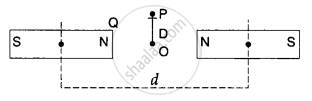
Two identical bar magnets are fixed with their centres at a distance d apart. A stationary charge Q is placed at P in between the gap of the two magnets at a distance D from the centre O as shown in the figure. The force on the charge Q is ______.
Earth's magnetic field analyses has a horizontal component except at:-
A paramagnetic sample shows a net magnetisation of 8 Am–1 when placed in an external magnetic field of 0.6 T at a temperature of 4 K. When the same sample is placed in an external magnetic field of 0.2 T at a temperature of 16 K, the magnetisation will be ______.
S is the surface of a lump of magnetic material.
- Lines of B are necessarily continuous across S.
- Some lines of B must be discontinuous across S.
- Lines of H are necessarily continuous across S.
- Lines of H cannot all be continuous across S.
Essential difference between electrostatic shielding by a conducting shell and magnetostatic shielding is due to ______.
- electrostatic field lines can end on charges and conductors have free charges.
- lines of B can also end but conductors cannot end them.
- lines of B cannot end on any material and perfect shielding is not possible.
- shells of high permeability materials can be used to divert lines of B from the interior region.
From molecular view point, discuss the temperature dependence of susceptibility for diamagnetism, paramagnetism and ferromagnetism.
If the magnetizing field on a ferromagnetic material is increased, its permeability ______.
Which of the following has a permeability less than that of free space?
Explain the Domain theory in brief.
What is the susceptibility of diamagnetic substances?
How do diamagnetic substances respond to a magnetic field?
Which list contains only examples of paramagnetic substances?
