Advertisements
Advertisements
Question
Draw magnetic field line when a (i) diamagnetic, (ii) paramagnetic substance is placed in an external magnetic field. Which magnetic property distinguishes this behaviour of the field line due to the substances?
Advertisements
Solution
(i) The magnetic field lines, when a diamagnetic material is placed in an external magnetic field, can be diagrammatically represented as
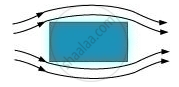
(ii) The magnetic field lines, when a paramagnetic material is placed in an external magnetic field, can be diagrammatically represented as
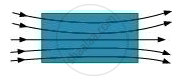
Diamagnetic and paramagnetic materials are distinguished by the magnetic property called magnetic susceptibility. For diamagnetic materials, magnetic susceptibility is negative, whereas for paramagnetic materials, magnetic susceptibility is slightly positive.
APPEARS IN
RELATED QUESTIONS
Relative permittivity and permeability of a material are `epsilon_"r"` and `µ_"r"` respectively. Which of the following values of these quantities are allowed for a diamagnetic material?
There are three needles 'N1', 'N2' and 'N3' made of a ferromagnetic, a paramagnetic and a diamagnetic substance respectively. When a magnet is brought close to them, then it will ____________.
If a toroid uses bismuth for its core, will the field in the core be (slightly) greater or (slightly) less than when the core is empty?
The magnetic susceptibility is negative for ______.
A permanent magnet in the shape of a thin cylinder of length 10 cm has M = 106 A/m. Calculate the magnetisation current IM.
Which of the following cannot modify an external magnetic field as shown in the figure?

The relative magnetic permeability of a substance X is slightly less than unity and that of substance Y is slightly more than unity, then ______.
What is the susceptibility of paramagnetic substances?
How do ferromagnetic substances respond to a magnetic field?
