Advertisements
Advertisements
Question
Answer in brief.
Discuss the Curie law for paramagnetic material.
Advertisements
Solution
Curie's law: The magnetization of a paramagnetic material is directly proportional to the external magnetic field and inversely proportional to the absolute temperature of the material.
If a paramagnetic material at an absolute temperature T is placed in an external magnetic field of induction `vec "B"_"ext"`, the magnitude of its magnetization
`"M"_"z" prop "B"_"ext"/"T"`
∴ `"M"_"z" = "C" "B"_"ext"/"T"`
where the proportionality constant C is called the Curie constant.
RELATED QUESTIONS
Distinguish between ‘paramagnetic’ and ‘ferromagnetic’ substances.
An iron rod of the area of cross-section 0.1m2 is subjected to a magnetizing field of 1000 A/m. Calculate the magnetic permeability of the iron rod. [Magnetic susceptibility of iron = 59.9, magnetic permeability of vacuum = 4π x 10-7 S. I. unit]
Out of the two magnetic materials, 'A' has relative permeability slightly greater than unity while 'B' has less than unity. Identify the nature of the materials 'A' and 'B'. Will their susceptibilities be positive or negative?
A meter gauge train is heading north with speed 54 km/hr in earth's magnetic field 3 x 10⁻⁴T. The e.m.f. induced across the axle joining the wheels is ..........
(a) 0.45 mV
(b) 4.5 mV
(c) 45 mV
(d) 450 m V
The magnetic susceptibility of annealed iron at saturation is 4224. Find the permeability of
annealed iron at saturation. (μ0 = 4Π × 10−7 SI unit)
Explain Curie’s law for a paramagnetic substance.
The relative magnetic permeability of a magnetic material is 800. Identify the nature of magnetic material and state its two properties.
Identify the following magnetic materials :
Which of the following statements is correct for diamagnetic materials?
The susceptibility of a paramagnetic material is χ at 27° C. At what temperature its susceptibility be χ/3?
A domain in a ferromagnetic substance is in the form of a cube of side 1 µm. If it contains 8 × 10¹⁰ atoms and each atomic dipole has a dipole moment of 9 × 10-24 Am2 then the magnetisation of the domain is ______.
For a paramagnetic substance, the magnetic susceptibility is ______.
The susceptibility of a magnetic material is positive and small. The material is ______.
The magnetic susceptibility of a paramagnetic material at - 73 °C is 0.0075. Its value at -173 °C will be ______.
Magnetization of the sample is ______.
If a magnetic field is applied to a liquid in one arm of a narrow U-tube, the liquid level in that arm is lowered. The liquid in U-tube arm is ______.
The materials having negative magnetic susceptibility are ____________.
The product of magnetic susceptibility (`chi`) and absolute temperature (T) is constant for a ____________.
A small quantity of paramagnetic liquid is taken in a watch - glass and kept on two dissimilar magnetic poles. The liquid ____________.
Which graph shows the variation of magnetic susceptibility (`chi`) with magnetizing field (H) for a paramagnetic substance?
Would the maximum possible magnetisation of a paramagnetic sample be of the same order of magnitude as the magnetisation of a ferromagnet?
Explain qualitatively on the basis of domain picture the irreversibility in the magnetisation curve of a ferromagnet.
A Rowland ring of mean radius 15 cm has 3500 turns of wire wound on a ferromagnetic core of relative permeability 800. What is the magnetic field B in the core for a magnetising current of 1.2 A?
Nickel shows ferromagnetic property at room temperature. If the temperature is increased beyond curie temperature, then it will show ______.
Assertion: The ferromagnetic substance do not obey Curie’s law.
Reason: At Curie point a ferromagnetic substance start behaving as a paramagnetic substance.
The coercivity of a small magnet where the ferromagnet gets demagnetized is 3 × 10³ Am–1. The current required to be passed in a solenoid of length 10 cm and number of turns 100, so that the magnet gets demagnetized when inside the solenoid, is ______.
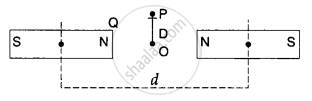
Two identical bar magnets are fixed with their centres at a distance d apart. A stationary charge Q is placed at P in between the gap of the two magnets at a distance D from the centre O as shown in the figure. The force on the charge Q is ______.
When a ferromagnetic material is created above its curie temperature
For a diamagnetic material
Most of the substance show which of the magnetic property:-
S is the surface of a lump of magnetic material.
- Lines of B are necessarily continuous across S.
- Some lines of B must be discontinuous across S.
- Lines of H are necessarily continuous across S.
- Lines of H cannot all be continuous across S.
A uniform magnetic field gets modified as shown in figure when two specimens A and B are placed in it.
 |
 |
| (a) | (b) |
- Identify the specimen A and B.
- How is the magnetic susceptibility of specimen A different from that of specimen B?
Magnetic susceptibility for a paramagnetic and diamagnetic materials is respectively ______.
Which of the following cannot modify an external magnetic field as shown in the figure?

Explain ferromagnetism on the basis of the domain theory.
Explain the origin of paramagnetism on the basis of atomic structure.
Match List-I with List-II.
| List-I (Material) | List-II (Susceptibility) | ||
| A. | Diamagnetic | I. | χ = 0 |
| B. | Ferromagnetic | II. | 0 > χ ≥ −1 |
| C. | Paramagnetic | III. | χ >> 1 |
| D. | Non-magnetic | IV. | 0 < χ < ε |
Choose the correct answer from the options given below:
Which substances are feebly magnetised in a direction opposite to that of the magnetising field?
Which substances are strongly magnetised in the direction of the magnetising field?
What is the susceptibility of paramagnetic substances?
How do diamagnetic substances respond to a magnetic field?
How do ferromagnetic substances respond to a magnetic field?
How does the magnetic susceptibility of a paramagnetic material vary with its absolute temperature under Curie's Law?
Which mathematical relation expresses Curie's Law for paramagnetic substances?
What happens to paramagnetic substances on cooling at the Curie temperature?
Which mathematical relation expresses Weiss Law for ferromagnetic substances above the Curie temperature?
What happens to ferromagnetic substances on heating beyond the Curie temperature?
How are the tiny domains oriented in an unmagnetised ferromagnetic specimen?
