Advertisements
Advertisements
Question
Which of the following substances is ductile?
Options
Glass
High carbon steel
Steel
Copper
Advertisements
Solution
Copper
APPEARS IN
RELATED QUESTIONS
Distinguish between ‘paramagnetic’ and ‘ferromagnetic’ substances.
Give any ‘two’ points of differences between diamagnetic and ferromagnetic substances.
An iron rod of the area of cross-section 0.1m2 is subjected to a magnetizing field of 1000 A/m. Calculate the magnetic permeability of the iron rod. [Magnetic susceptibility of iron = 59.9, magnetic permeability of vacuum = 4π x 10-7 S. I. unit]
The susceptibility of magnesium at 200 K is 1.8 x 10⁻⁵. At what temperature will the susceptibility decrease by 6 x 10⁻⁶?
Show diagrammatically the behaviour of magnetic field lines in the presence of (i) paramagnetic and (ii) diamagnetic substances. How does one explain this distinguishing feature?
A meter gauge train is heading north with speed 54 km/hr in earth's magnetic field 3 x 10⁻⁴T. The e.m.f. induced across the axle joining the wheels is ..........
(a) 0.45 mV
(b) 4.5 mV
(c) 45 mV
(d) 450 m V
The susceptibility of a magnetic material is − 2.6 × 10⁻⁵. Identify the type of magnetic material and state its two properties.
Draw magnetic field line when a (i) diamagnetic, (ii) paramagnetic substance is placed in an external magnetic field. Which magnetic property distinguishes this behaviour of the field line due to the substances?
Two substances A and B have their relative permeability slightly greater and slightly less than 1 respectively. What do you conclude about A and B as far as their magnetic materials are concerned?
Identify the following magnetic materials :
Two identical bar magnets each of magnetic moment M, separated by some distance are kept perpendicular to each other. The magnetic induction at a point at the same distance d from the centre of magnets, is (µ0 = permeability of free space)
For a paramagnetic substance, the magnetic susceptibility is ______.
The magnetic susceptibility of a paramagnetic material at - 73 °C is 0.0075. Its value at -173 °C will be ______.
All atoms of a magnetic substance have a resultant magnetic moment even in absence of external magnetic field. The substance is ______.
Magnetization of the sample is ______.
The product of magnetic susceptibility (`chi`) and absolute temperature (T) is constant for a ____________.
A sphere of gold when brought towards a powerful magnet experiences ____________.
A domain in a ferromagnetic substance is in the form of a cube of side length 1 µm. If it contains 6 x 10¹⁰ atoms and each atomic dipole has a dipole moment of 7 x 10-24 Am2, then magnetization of the domain is ____________.
Which graph shows the variation of magnetic susceptibility (`chi`) with magnetizing field (H) for a paramagnetic substance?
Why does a paramagnetic sample display greater magnetisation (for the same magnetising field) when cooled?
Would the maximum possible magnetisation of a paramagnetic sample be of the same order of magnitude as the magnetisation of a ferromagnet?
A certain region of space is to be shielded from magnetic fields. Suggest a method.
Assertion: A paramagnetic sample display greater magnetisation (for the same magnetic field) when cooled.
Reason: The magnetisation does not depend on temperature.
Metals getting magnetised by orientation of atomic magnetic moments in external magnetic field are called ______.
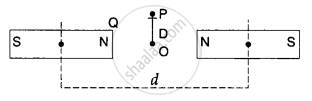
Two identical bar magnets are fixed with their centres at a distance d apart. A stationary charge Q is placed at P in between the gap of the two magnets at a distance D from the centre O as shown in the figure. The force on the charge Q is ______.
When a ferromagnetic material is created above its curie temperature
Most of the substance show which of the magnetic property:-
A long solenoid has 1000 turns per metre and carries a current of 1 A. It has a soft iron core of µr = 1000. The core is heated beyond the Curie temperature, Tc.
- The H field in the solenoid is (nearly) unchanged but the B field decreases drastically.
- The H and B fields in the solenoid are nearly unchanged.
- The magnetisation in the core reverses direction.
- The magnetisation in the core diminishes by a factor of about 108.
Explain quantitatively the order of magnitude difference between the diamagnetic susceptibility of N2 (~5 × 10⁻⁹) (at STP) and Cu (~10–5).
- Assertion (A): Diamagnetic substances exhibit magnetism.
- Reason (R): Diamagnetic materials do not have a permanent magnetic dipole moment.
Explain ferromagnetism on the basis of the domain theory.
State the dimensions of magnetization.
Explain the Domain theory in brief.
Magnetic susceptibility of a diamagnetic substance ______.
Which substances are feebly magnetised in a direction opposite to that of the magnetising field?
Which substances are feebly magnetised in the direction of the magnetising field?
Which substances are strongly magnetised in the direction of the magnetising field?
What is the susceptibility of diamagnetic substances?
What is the susceptibility of paramagnetic substances?
Which list contains only examples of paramagnetic substances?
Which list contains only examples of ferromagnetic substances?
How does the magnetic susceptibility of a paramagnetic material vary with its absolute temperature under Curie's Law?
Which mathematical relation expresses Weiss Law for ferromagnetic substances above the Curie temperature?
How are the tiny domains oriented in an unmagnetised ferromagnetic specimen?
In the small-arrows analogy for ferromagnets, when does the total effect become strong?
