Advertisements
Advertisements
प्रश्न
Answer the following question.
What are the advantages of optical fibre communication over electronic communication?
Advertisements
उत्तर
Advantages:
- Broad bandwidth (frequency range): For TV signals, a single optical fibre can carry over 90000 independent signals (channels).
- Immune to EM interference: Optical fibre being electrically non-conductive, does not pick up nearby EM signals.
- Low attenuation loss: loss being lower than 0.2 dB/km, a single long cable can be used for several kilometres.
- Electrical insulator: Optical fibres being electrical insulators, ground loops of metal wires or lightning do not cause any harm.
- Theft prevention: Optical fibres do not use copper or other expensive material which are prone to be robbed.
- Security of information: Internal damage is most unlikely to occur, keeping the information secure.
APPEARS IN
संबंधित प्रश्न
Draw the diagram of a right-angled isosceles prism which is used to make an invented image erect.
Angle of deviation is the angle which the ______ ray makes with the direction of ______ray.
State two conditions necessary for total internal reflection to occur.
Write the necessary conditions for the phenomenon of total internal reflection to
occur ?
Plot a graph between
Angle of incidence versus angle of refraction.
How does a ray of light bend when it travels from denser to rarer medium.
Can light be ‘piped’ like sound in a doctor’s stethoscope?
Images formed by totally reflecting prisms are brighter than the image formed by ordinary reflected light, why?
State one factor on which a critical angle for a given pair of media depends. The critical angle for the glass-air interface is 45° for the yellow light. Will it be equal to, less than or greater than 45° for (i) red light, (ii) blue light?
A ray of light passes through a right-angled prism as shown in the figure. State the angles of incidence at the faces AC and BC.
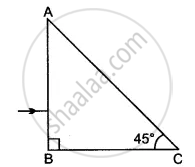
Complete the following diagram to show the path of the ray of a single colour in the diagram as if enters in and emerges out of the prism. Mark the angles wherever necessary. (Critical angle for glass = 42°).
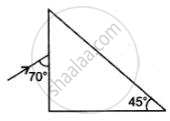
PQ and PR are two light rays emerging from the object as shown in the figure below:

(i) What is the special name given to the angle of incidence (∠PQN) of ray PQ?
(ii) Copy the ray diagram and complete it to show the position of the image of the object P when seen obliquely from above.
(iii) Name the phenomenon that occurs if the angle of incidence ∠PQN is increased still further.
Choose the correct option.
Consider the following phenomena/ applications: P) Mirage, Q) rainbow, R) Optical fibre and S) glittering of a diamond. Total internal reflection is involved in
A spherical marble, of refractive index 1.5 and curvature 1.5 cm, contains a tiny air bubble at its centre. Where will it appear when seen from outside?
Choose the correct option.
Select the WRONG statement.
Solve Numerical example.
A monochromatic ray of light is incident at 37° on an equilateral prism of refractive index 3/2. Determine angle of emergence and angle of deviation. If angle of prism is adjustable, what should its value be for emergent rays to be just possible for the same angle of incidence?
Critical angle of light passing from glass to air is maximum for ____________.
Which one of the following is NOT the correct formula for refractive index of glass w.r.t. air (aμg) (i = angle of incidence, r = angle of refraction)
Which of the following statements about total internal reflection is true?
Optical Fibres are based on the phenomenon of dispersion.
What is the phenomenon used in optical fiber? Explain.
A green light is incident from the water to the air-water interface at the critical angle (θ). Select the correct statement.
State the condition under which total internal reflection occurs. Give the mathematical expression for total internal reflection.
- Assertion (A): Propagation of light through an optical fibre is due to total internal reflection taking place at the core-cladding interface.
- Reason (R): Refractive index of the material of the cladding of the optical fibre is greater than that of the core.
An endoscope uses optic fiber to transmit high resolution images of internal organs without loss of information. The principle of light that is used by the optic fiber is based on ______.
The diagram below shows a fish in the tank and its image seen on the surface of the water.
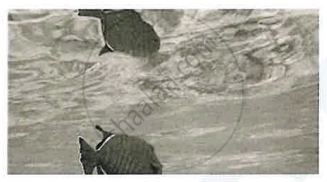
Name the phenomenon responsible for the formation of this image.
