Advertisements
Advertisements
प्रश्न
Fig shows a lens as a combination of a glass block and two prisms.
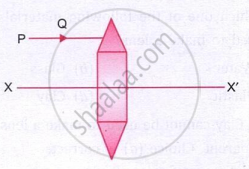
- Name the lens formed by the combination.
- What is the line XX' called?
- Complete the path of the incident ray PQ after passing through the lens.
- The final emergent ray either meets XX' at a point or appears to come from a point on XX'. Label it as F, What is this point called?
Advertisements
उत्तर
- It is a convex (converging) lens.
- XX′ is the principal axis.

Since PQ is parallel to the principal axis, after refraction it passes through the principal focus on the other side of the convex lens.- The point is the principal focus (second principal focus).
APPEARS IN
संबंधित प्रश्न
What is a spectrum?
When a ray of light from air enters a denser medium, it ______.
The highest refractive index is of ______.
After tracing the path of rays of light through a glass slab for three different angles of incidence, a student measured the corresponding values angle of refraction r and angle of emergence e and recorded them in the table given below:
|
S. No. |
∠i |
∠i |
∠e |
|
I |
30° |
20° |
31° |
|
II |
40° |
25° |
40° |
|
III |
50° |
31° |
49° |
The correct observations are:
(A) I and II
(B) II and III
(C) I and III
(D) I, II and III
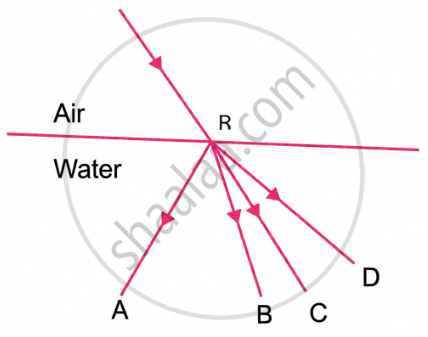
A ray of light passes from air to water. In fig., which of the ray A, B, C and D is the correct refracted ray?
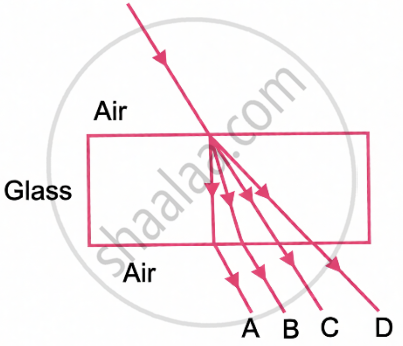
In the fig. name the ray which represents the correct path of light while passing through a glass block.
What is the refractive index of water
Draw ray of light bending towards the normal while passing from glass to water. Label your diagrams.
Light passes through a rectangular glass slab and through a triangular glass prism. In what way does the direction of the two emergent beams differ and why?
