Advertisements
Advertisements
प्रश्न
Light passes through a rectangular glass slab and through a triangular glass prism. In what way does the direction of the two emergent beams differ and why?
Advertisements
उत्तर
In rectangular glass slab, the ray undergoes the only refraction and emerges out parallel. In a prism, the emerging ray is not parallel but split due to change in wavelength of different colour of light. The shape of the glass slab with two prisms up and down splits light but recombines it into one.


APPEARS IN
संबंधित प्रश्न
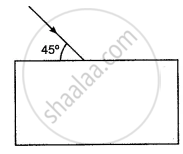
Draw the diagram given below and clearly show the path taken by the emergent ray.
The highest refractive index is of ______.
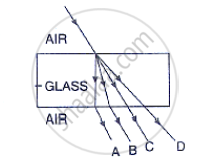
In fig 4.18, name the ray which represents the correct path of light while emerging out through a glass block.
The critical angle for glass-air is 45° for the light of yellow colour. State whether it will be less than, equal to, or more than 45° for (i) ref light, (ii) blue light?
“A ray of light incident on a rectangular glass slab immersed in any medium emerges parallel to itself.” Draw labelled ray diagram to justify the statement.
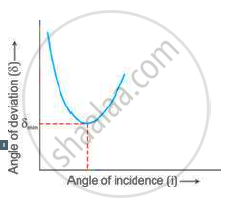
Using the curve, how do you infer that for given prism, the angle of minimum deviation δmin is unique for the given light?
Name the phenomenon responsible in the following case:
Apparent bending of a stick in water
What is the refractive index of water
Draw a diagram to show the refraction of a monochromatic light ray through an equilateral prism. On the diagram, label the incident, refracted, and emergent rays. It also indicates the angle of deviation by the letter δ.
