Advertisements
Advertisements
प्रश्न
Ranbir claims to have obtained an image twice the size of the object with a concave lens. Is he correct? Give a reason for your answer.
A student claims to have obtained an image twice the size of object with a concave lens. Is he correct? Give a reason for your answer.
Advertisements
उत्तर
No, he is not correct.
Reason: Magnified image of an object cannot be formed by a concave lens ever. Because, no matter where the object is placed in front of a concave lens, it always forms a virtual, erect, and diminished image of the object.
APPEARS IN
संबंधित प्रश्न
What can you see in a completely dark room? If you switch on an electric bulb in this dark room as a light source, explain how you could now see:
(a) the electric bulb
(b) a piece of white paper
State the condition for the following a lens has both its focal lengths equal .
A symmetric double convex lens in cut in two equal parts by a plane perpendicular to the principal axis. If the power of the original lens was 4 D, the power a cut-lens will be
A 5.0 diopter lens forms a virtual image which is 4 times the object placed perpendicularly on the principal axis of the lens. Find the distance of the object from the lens.
A diverging lens of focal length 20 cm and a converging lens of focal length 30 cm are placed 15 cm apart with their principal axes coinciding. Where should an object be placed on the principal axis so that its image is formed at infinity?
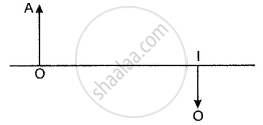
The following diagram shows the object O and the image I formed by a lens. Copy the diagram and on it mark the positions of the lens LL’ and focus (F). Name the lens.
Power of a lens is – 4D, then its focal length is
Define power of a lens. What is its unit? One student uses a lens of focal length 50 cm and another of –50 cm. What is the nature of the lens and its power used by each of them?
A point object is placed at O in front of a glass sphere as shown in figure.

Show the formation of the image by the sphere.
The power of a lens in dioptres is given by:
