Advertisements
Advertisements
प्रश्न
Consider three converging lenses L1, L2 and L3 having identical geometrical construction. The index of refraction of L1 and L2 are \[\mu_1 \text{ and } \mu_2\] respectively. The upper half of the lens L3 has a refractive index \[\mu_1\] and the lower half has \[\mu_2\] following figure . A point object O is imaged at O1 by the lens L1 and at O2 by the lens L2placed in same position. If L3 is placed at the same place,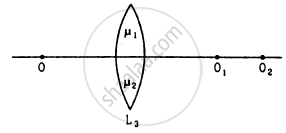
(a) there will be an image at O1
(b) there will be an image at O2.
(c) the only image will form somewhere between O1 and O2
(d) the only image will form away from O2.
Advertisements
उत्तर
(a) there will be an image at O1
(b) there will be an image at O2
The lens L1 converges the light at point O1 and lens L2 converges the light at O2. As the upper half of lens L3 has a refractive index equal to that of L1, it will converge the light at O1 and thus the image will be formed at O1. Also, the lower half of lens L3 has a refractive index equal to that of lens L2, it will converge the light at O2 and thus the image will be formed at O2.
APPEARS IN
संबंधित प्रश्न
Find the power of a concave lens of focal length 2m.
What is the focal length of a convex lens of focal length 30 cm in contact with a concave lens of focal length 20 cm? Is the system a converging or a diverging lens? Ignore thickness of the lenses.
Kavita from 10th is using spectacles. The power of the lenses in her spectacles is –2.5 dioptre. Answer the following questions:
1) Which lenses are used in her spectacles?
2) State the defect of vision Kavita is suffering from.
3) Find the focal length of the lenses used in her spectacles
Consider two statements A and B given below:
A: real image is always inverted
B: virtual image is always erect
Out of these two statements:
Which has more power : a thick convex lens or a thin convex lens, made of the same glass? Give reason for your choice.
What is the nature of a lens having a power of + 0.5 D?
Two lenses A and B have focal lengths of +20 cm and, −10 cm, respectively.
(a) What is the nature of lens A and lens B?
(b) What is the power of lens A and lens B?
(c) What is the power of combination if lenses A and B are held close together?
How is the sign (+ or -) of power of a lens related to its divergent or convergent action?
On reducing the focal length of a lens, its power ______.
Find the radius of curvature of the convex surface of a plano-convex lens, whose focal length is 0.3 m and the refractive index of the material of the lens is 1.5.
A diverging lens of focal length 20 cm and a converging lens of focal length 30 cm are placed 15 cm apart with their principal axes coinciding. Where should an object be placed on the principal axis so that its image is formed at infinity?
The power of a lens is +2.0 D. Find its focal length and state the kind of lens.
If focal length of a convex lens is 20 cm at what is the power of the lens?
Assertion and reasoning type
- Assertion: Myopia is due to the increase in the converging power of eye lens.
- Reason: Myopia can be corrected with the help of concave lens.
Define power of a lens. What is its unit? One student uses a lens of focal length 50 cm and another of –50 cm. What is the nature of the lens and its power used by each of them?
An object is placed in front of a converging lens. Obtain the conditions under which the magnification produced by the lens is
- negative and
- positive.
When monochromatic red light is used instead of blue light in a convex lens, its focal length will ______.
For a lens immersed in a medium of refractive index \[n_1\], the power is related to the focal length by:
If the refractive index of the lens material is less than that of the surrounding liquid (\[n_2 < n_1\]), then:
The power of a lens of focal length \[f = 0.5\,m\] is:
