Advertisements
Advertisements
प्रश्न
A diverging lens of focal length 20 cm and a converging lens of focal length 30 cm are placed 15 cm apart with their principal axes coinciding. Where should an object be placed on the principal axis so that its image is formed at infinity?
Advertisements
उत्तर
Given,
Focal length of convex lens, fc = 30 cm
Focal length of concave lens, fd = 15 cm
Distance between both the lenses, d = 15 cm
Let (f) be the equivalent focal length of both the lenses.\[\frac{1}{f} = \frac{1}{f_1} + \frac{1}{f_2} - \frac{d}{f_1 f_2}\]
\[ = \frac{1}{30} + \left( \frac{1}{20} \right) - \left( \frac{5}{30( - 20)} \right)\]
\[ = \frac{1}{120}\]
\[\Rightarrow f=120 \text{ cm }\]
As focal length is positive, so it will be a converging lens.
Let 'd1' be the distance from diverging lens, so that the emergent beam is parallel to the principal axis and the image will be formed at infinity.
\[d_1 = \frac{df}{f_c} = \frac{15 \times 120}{30} = 60 \text{ cm }\]
It should be placed 60 cm left to the diverging lens. The object should be placed
(120 − 60) = 60 cm from the diverging lens
Let d2 be the distance from the converging lens. Then,
\[d_2 = \frac{df}{f_d} = \frac{15 \times 120}{20}\]
d2 = 90 cm
Thus, it should be placed (120 + 90) cm = 210 cm right to converging lens.
APPEARS IN
संबंधित प्रश्न
How unit of power related to focal length of a lens?
What is the nature of a lens having a power of + 0.5 D?
What is the nature of a lens whose power is, −4 D?
A doctor has prescribed a corrective lens of power, −1.5 D. Find the focal length of the lens. Is the prescribed lens diverging or converging?
A lens has a focal length of, −10 cm. What is the power of the lens and what is its nature?
What do you understand by the power of a lens?
A converging lens has a focal length of 50 cm. The power of this lens is:
Define the term focal length of a lens.
How is the sign (+ or -) of power of a lens related to its divergent or convergent action?
Consider three converging lenses L1, L2 and L3 having identical geometrical construction. The index of refraction of L1 and L2 are \[\mu_1 \text{ and } \mu_2\] respectively. The upper half of the lens L3 has a refractive index \[\mu_1\] and the lower half has \[\mu_2\] following figure . A point object O is imaged at O1 by the lens L1 and at O2 by the lens L2placed in same position. If L3 is placed at the same place,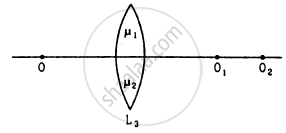
(a) there will be an image at O1
(b) there will be an image at O2.
(c) the only image will form somewhere between O1 and O2
(d) the only image will form away from O2.
A convex lens is of focal length 20 cm. Find its power.
The focal length of a concave lens is 20 cm. The focal length of a convex lens is 25 cm. These two are placed in contact with each other. What is the power of the combination? Is it diverging, converging or undeviating in nature?
A convex lens with radii of curvature R1 = R2 is immersed in water. Assuming that the refractive indices of glass and water are 3/2 and 4/3 respectively, its focal length f1 in comparison to that in air, f, is ______.
The focal length of a double convex lens is equal to the radius of curvature of either surface. What is the refractive index of its material?
In what unit is the power of a lens expressed?
A convex lens is a converging lens whose focal length and power are both:
A concave lens is a diverging lens whose focal length and power are both:
A negative power of a lens indicates a:
A greater numerical value of the power of a lens means:
