Advertisements
Advertisements
प्रश्न
The lens mentioned in 6(b) above is of focal length 25cm. Calculate the power of the lens.
Advertisements
उत्तर
Focal length of a convex lens is always positive.
Given: f = +25 cm
`therefore P=1/f`
`P=1/25`
`P=+0.04D`
APPEARS IN
संबंधित प्रश्न
Consider two statements A and B given below:
A: real image is always inverted
B: virtual image is always erect
Out of these two statements:
The power of a lens is, −2 D. What is its focal length?
A lens has a focal length of, −10 cm. What is the power of the lens and what is its nature?
A double convex lens has two surfaces of equal radii R and refractive index \[m = 1 \cdot 5\]
A double convex lens has focal length 25 cm. The radius of curvature of one of the surfaces is double of the other. Find the radii, if the refractive index of the material of the lens is 1.5.
The power of a lens is +2.0 D. Find its focal length and state the kind of lens.
Complete the diagram to show the formation of the image of the object AB.
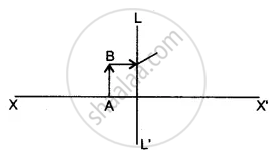
(i) Name the Lens LL’.
(ii) Where is the image of the object AB formed?
(iii) State three characteristics of the image.
An object is placed in front of a converging lens. Obtain the conditions under which the magnification produced by the lens is
- negative and
- positive.
The same size images are formed by a convex lens when the object is placed at 20 cm or at 10 cm from the lens. The focal length of convex lens is ______ cm.
The lens of power + 1·0 D is ______.
