Advertisements
Advertisements
प्रश्न
The power of convex lens of focal length 20 cm is ______.
पर्याय
+5.0 D
0.20 D
-5.0 D
0.5 D
Advertisements
उत्तर
The power of convex lens of focal length 20 cm is +5.0 D.
Explanation:
Given: Focal length = f = 20 cm = 0.2 m
Power of the lens = P = ?
P = `1/("f"("m"))`
= `1/0.2`
= 5 D
The power of the lens is 5 D.
APPEARS IN
संबंधित प्रश्न
What is meant by a power of a lens? Define its SI unit.
What does sign of power (+ve or –ve) indicate?
How unit of power related to focal length of a lens?
Find the power of a concave lens of focal length 2m.
What is the focal length of a convex lens of focal length 30 cm in contact with a concave lens of focal length 20 cm? Is the system a converging or a diverging lens? Ignore thickness of the lenses.
You have two lenses A and B of focal lengths +10 cm and –10 cm, respectively. State the nature and power of each lens. Which of the two lenses will form a virtual and magnified image of an object placed 8 cm from the lens? Draw a ray diagram to justify your answer
Ranbir claims to have obtained an image twice the size of the object with a concave lens. Is he correct? Give a reason for your answer.
Kavita from 10th is using spectacles. The power of the lenses in her spectacles is –2.5 dioptre. Answer the following questions:
1) Which lenses are used in her spectacles?
2) State the defect of vision Kavita is suffering from.
3) Find the focal length of the lenses used in her spectacles
A student uses a lens of focal length 40 cm and another of –20 cm. Write the nature and power of each lens
Give the usual name for the following:
A point inside a lens through which the light passes undeviated.
Name the physical quantity whose unit is dioptre.
Which has more power : a thick convex lens or a thin convex lens, made of the same glass? Give reason for your choice.
The focal length of a convex lens is 25 cm. What is its power?
The power of a lens is, −2 D. What is its focal length?
What is the nature of a lens whose power is, −4 D?
A convex lens of power 5 D and a concave lens of power 7.5 D are placed in contact with each other. What is the :
(a) power of this combination of lenses?
(b) focal length of this combination of lenses?
The power of a combination of two lenses X and Y is 5 D. If the focal length of lens X be 15 cm :
(a) calculate the focal length of lens Y.
(b) state the nature of lens Y.
A combination of lenses for a camera contains two converging lenses of focal lengths 20 cm and 40 cm and a diverging lens of focal length 50 cm. Find the power and focal length of the combination.
Define the term focal length of a lens.
How is the sign (+ or -) of power of a lens related to its divergent or convergent action?
Express the power (with sign) of a concave lens of focal length 20 cm.
Name the type of lens whose power is positive.
The image of an object formed by a lens is real, inverted and of the same size as the object. If the image is at a distance of 40 cm from the lens, what is the nature and power of the lens ? Draw ray diagram to justify your answer.
Define power of a lens. Write its units. Deduce the relation `1/f =1/f_1 +1/f_2`for two thin lenses kept in contact coaxially.
A double convex lens has two surfaces of equal radii R and refractive index \[m = 1 \cdot 5\]
A screen is placed a distance 40 cm away from an illuminated object. A converging lens is placed between the source and the screen and its is attempted to form the image of the source on the screen. If no position could be found, the focal length of the lens
A 5.0 diopter lens forms a virtual image which is 4 times the object placed perpendicularly on the principal axis of the lens. Find the distance of the object from the lens.
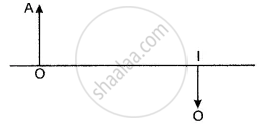
The following diagram shows the object O and the image I formed by a lens. Copy the diagram and on it mark the positions of the lens LL’ and focus (F). Name the lens.
A stick partly immersed in water appears to be bent. Draw a ray diagram to show the bending of the stick when placed in water and viewed obliquely from above.
A convex lens is of focal length 20 cm. Find its power.
If there is a convex lens of focal length 75 cm and a concave lens of focal length 40 cm, then calculate their combined power and combined focal length.
Find the power of a convex lens of focal length of + 25 cm.
If focal length of a convex lens is 20 cm at what is the power of the lens?
Assertion and reasoning type
- Assertion: Myopia is due to the increase in the converging power of eye lens.
- Reason: Myopia can be corrected with the help of concave lens.
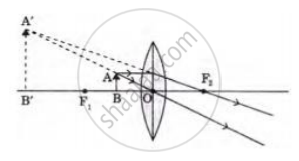
The above lens has a focal length of 10 cm. The object of height 2 mm is placed at a distance of 5 cm from the pole. Find the height of the image.
Define power of a lens. What is its unit? One student uses a lens of focal length 50 cm and another of –50 cm. What is the nature of the lens and its power used by each of them?
The focal length of a double convex lens is equal to the radius of curvature of either surface. What is the refractive index of its material?
