Advertisements
Advertisements
प्रश्न
The optician's prescription for a spectacle lens is marked +0.5 D. What is the:
(a) nature of spectacle lens?
(b) focal length of spectacle lens?
Advertisements
उत्तर
Positive power indicates it is a converging lens.
Power of a lens is given by:
power(p)=`1/f`
`0.5=1/f`
`f=1/0.5`
`f=2m`
APPEARS IN
संबंधित प्रश्न
What is meant by a power of a lens? Define its SI unit.
Ranbir claims to have obtained an image twice the size of the object with a concave lens. Is he correct? Give a reason for your answer.
Consider two statements A and B given below:
A: real image is always inverted
B: virtual image is always erect
Out of these two statements:
A combination of lenses for a camera contains two converging lenses of focal lengths 20 cm and 40 cm and a diverging lens of focal length 50 cm. Find the power and focal length of the combination.
The power of a lens is +2.0D. Its focal length should be :
State the condition for the following a lens has both its focal lengths equal .
A symmetric double convex lens is cut in two equal parts by a plane containing the principal axis. If the power of the original lens was 4 D, the power of a divided lens will be
A double convex lens has focal length 25 cm. The radius of curvature of one of the surfaces is double of the other. Find the radii, if the refractive index of the material of the lens is 1.5.
The power of a lens is +2.0 D. Find its focal length and state the kind of lens.
Complete the diagram to show the formation of the image of the object AB.
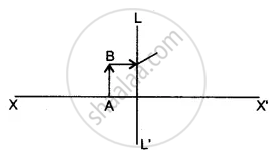
(i) Name the Lens LL’.
(ii) Where is the image of the object AB formed?
(iii) State three characteristics of the image.
If the lens is of focal length 25 cm. Calculate the power of the lens.
Focal length : metre : : power of lens : _______
If focal length of a convex lens is 20 cm at what is the power of the lens?
Power of a lens is – 4D, then its focal length is
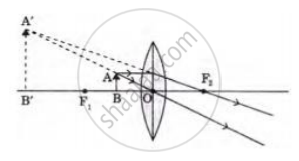
The above lens has a focal length of 10 cm. The object of height 2 mm is placed at a distance of 5 cm from the pole. Find the height of the image.
The power of a lens is defined as the:
A positive power of a lens indicates a:
When a lens is placed in a liquid, light refracts at:
If the refractive index of the lens material is less than that of the surrounding liquid (\[n_2 < n_1\]), then:
