Advertisements
Advertisements
प्रश्न
Find the power of a convex lens of focal length of + 25 cm.
Advertisements
उत्तर
Given: Focal length (f) = 25 cm = 0.25 m
To find: Power of the lens (P)
Formula: P = `1/("f"("m"))`
Calculation: From formula, P = `1/0.25` = 4 D
The power of the convex lens is 4 D.
APPEARS IN
संबंधित प्रश्न
Calculate the focal length of a corrective lens having power +2.5 D.
What does sign of power (+ve or –ve) indicate?
Find the power of a concave lens of focal length 2m.
Find the focal length of a lens of power −2.0 D. What type of lens is this?
Consider two statements A and B given below:
A: real image is always inverted
B: virtual image is always erect
Out of these two statements:
Give the usual name for the following:
A point inside a lens through which the light passes undeviated.
A converging lens has focal length of 50 mm. What is the power of the lens?
A diverging lens has focal length of 3 cm. Calculate the power.
What is the nature of a lens whose power is, −4 D?
A doctor has prescribed a corrective lens of power, −1.5 D. Find the focal length of the lens. Is the prescribed lens diverging or converging?
The focal length of a lens is +150 mm. What kind of lens is it and what is its power?
An object of height 4 cm is placed at a distance of 15 cm in front of a concave lens of power, −10 dioptres. Find the size of the image.
Two lenses A and B have focal lengths of +20 cm and, −10 cm, respectively.
(a) What is the nature of lens A and lens B?
(b) What is the power of lens A and lens B?
(c) What is the power of combination if lenses A and B are held close together?
The power of a lens is +2.0D. Its focal length should be :
Name the type of lens whose power is positive.
The image of an object formed by a lens is real, inverted and of the same size as the object. If the image is at a distance of 40 cm from the lens, what is the nature and power of the lens ? Draw ray diagram to justify your answer.
How does focal length of a lens change when red light incident on it is replaced by violet light? Give reason for your answer.
Define power of a lens. Write its units. Deduce the relation `1/f =1/f_1 +1/f_2`for two thin lenses kept in contact coaxially.
Find the radius of curvature of the convex surface of a plano-convex lens, whose focal length is 0.3 m and the refractive index of the material of the lens is 1.5.
A thin converging lens is formed with one surface convex and the other plane. Does the position of image depend on whether the convex surface or the plane surface faces the object?
A symmetric double convex lens in cut in two equal parts by a plane perpendicular to the principal axis. If the power of the original lens was 4 D, the power a cut-lens will be
A screen is placed a distance 40 cm away from an illuminated object. A converging lens is placed between the source and the screen and its is attempted to form the image of the source on the screen. If no position could be found, the focal length of the lens
A pin of length 2.00 cm is placed perpendicular to the principal axis of a converging lens. An inverted image of size 1.00 cm is formed at a distance of 40.0 cm from the pin. Find the focal length of the lens and its distance from the pin.
Which lens has more power a thick lens or a thin lens?
The power of a lens is +2.0 D. Find its focal length and state the kind of lens.
A lens forms an upright and diminished image of an object, irrespective of its position. What kind of lens is this? Draw an outline ray diagram to show the formation of the image. State the position and one more characteristic of the image.
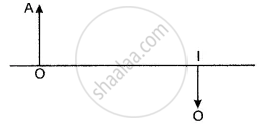
The following diagram shows the object O and the image I formed by a lens. Copy the diagram and on it mark the positions of the lens LL’ and focus (F). Name the lens.
A convex lens is of focal length 20 cm. Find its power.
The power of the magnifying glass depends on the distance of the magnifying glass from object.
The power of lens depends on the focal length of the lens
An object is placed in front of a converging lens. Obtain the conditions under which the magnification produced by the lens is
- negative and
- positive.
The focal length of a double convex lens is equal to the radius of curvature of either surface. What is the refractive index of its material?
The deviation of the incident light rays produced by a lens on refraction through it is a measure of its:
One dioptre is the power of a lens whose focal length is:
A convex lens is a converging lens whose focal length and power are both:
