Advertisements
Advertisements
प्रश्न
A lens forms an upright and diminished image of an object, irrespective of its position. What kind of lens is this? Draw an outline ray diagram to show the formation of the image. State the position and one more characteristic of the image.
Advertisements
उत्तर
A concave (or diverging) lens forms an upright and diminished image of an object irrespective of its position.

The outline ray diagram showing the formation of the image is given in figure. For the object AB, the image is A’B’.
The image is formed between optical centre O and focus F, in front of the lens.
The image is virtual.
संबंधित प्रश्न
Calculate the focal length of a corrective lens having power +2D.
What is meant by a power of a lens? Define its SI unit.
Define the power of a lens.
Find the power of a concave lens of focal length 2m.
The lens A has a focal length of 25 cm whereas another lens B has a focal length of 60 cm. Giving reason state, which lens has more power: A or B.
What is the power of a convex lens of focal length 0.5 m?
What do you understand by the power of a lens?
Define the term focal length of a lens.
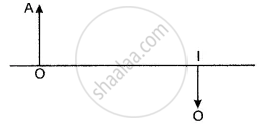
The following diagram shows the object O and the image I formed by a lens. Copy the diagram and on it mark the positions of the lens LL’ and focus (F). Name the lens.
When a lens is placed in a liquid, the total power of the lens is:
