Advertisements
Advertisements
प्रश्न
Find the power of a convex lens of focal length of + 25 cm.
Advertisements
उत्तर
Given: Focal length (f) = 25 cm = 0.25 m
To find: Power of the lens (P)
Formula: P = `1/("f"("m"))`
Calculation: From formula, P = `1/0.25` = 4 D
The power of the convex lens is 4 D.
APPEARS IN
संबंधित प्रश्न
Define the power of a lens.
Define 1 dioptre of power of a lens.
Ranbir claims to have obtained an image twice the size of the object with a concave lens. Is he correct? Give a reason for your answer.
The lens mentioned in 6(b) above is of focal length 25cm. Calculate the power of the lens.
A student uses a lens of focal length 40 cm and another of –20 cm. Write the nature and power of each lens
Which type of lens has a positive power?
The power of a lens is + 0.2 D. Calculate its focal length.
A doctor has prescribed a corrective lens of power, −1.5 D. Find the focal length of the lens. Is the prescribed lens diverging or converging?
An object of height 4 cm is placed at a distance of 15 cm in front of a concave lens of power, −10 dioptres. Find the size of the image.
A convex lens of power 5 D and a concave lens of power 7.5 D are placed in contact with each other. What is the :
(a) power of this combination of lenses?
(b) focal length of this combination of lenses?
The power of a combination of two lenses X and Y is 5 D. If the focal length of lens X be 15 cm :
(a) calculate the focal length of lens Y.
(b) state the nature of lens Y.
A diverging lens has a focal length of 0.10 m. The power of this lens will be:
The power of a lens is +2.0D. Its focal length should be :
How is the power of a lens related to its focal length?
A double convex lens has two surfaces of equal radii R and refractive index \[m = 1 \cdot 5\]
A screen is placed a distance 40 cm away from an illuminated object. A converging lens is placed between the source and the screen and its is attempted to form the image of the source on the screen. If no position could be found, the focal length of the lens
A pin of length 2.00 cm is placed perpendicular to the principal axis of a converging lens. An inverted image of size 1.00 cm is formed at a distance of 40.0 cm from the pin. Find the focal length of the lens and its distance from the pin.
The power of a lens is +2.0 D. Find its focal length and state the kind of lens.
A lens forms an upright and diminished image of an object, irrespective of its position. What kind of lens is this? Draw an outline ray diagram to show the formation of the image. State the position and one more characteristic of the image.
Complete the diagram to show the formation of the image of the object AB.
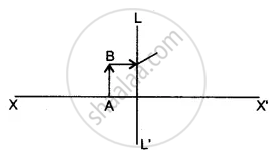
(i) Name the Lens LL’.
(ii) Where is the image of the object AB formed?
(iii) State three characteristics of the image.
If the lens is of focal length 25 cm. Calculate the power of the lens.
If there is a convex lens of focal length 75 cm and a concave lens of focal length 40 cm, then calculate their combined power and combined focal length.
According to Rayleigh’s scattering law, the amount of scattering of light is inversely proportional to the fourth power of its ______.
When monochromatic red light is used instead of blue light in a convex lens, its focal length will ______.
The lens of power + 1·0 D is ______.
The power of a lens is defined as the:
The SI unit of the power of a lens is the:
1 D is equivalent to:
The power of a lens in dioptres is given by:
A concave lens is a diverging lens whose focal length and power are both:
A greater numerical value of the power of a lens means:
If the lens material and the surrounding liquid have the same refractive index (\[n_2 = n_1\]), then:
A lens has a power of \[+2\,D\]. Its focal length is:
For a lens with \[f = +12\,cm\], \[R_1 = +10\,cm\] and \[R_2 = -15\,cm\], the lens maker's formula \[\frac{1}{f}=(n-1)\left(\frac{1}{R_1}-\frac{1}{R_2}\right)\] gives the refractive index of the glass as:
