Advertisements
Advertisements
प्रश्न
Mohan obtained a sharp inverted image of a distant tree on the screen placed behind the lens. He then moved the screen and tried to look through the lens in the direction of the object. He would see:
(1) a blurred image on the wall of the laboratory.
(2) an erect image of the tree on the lens.
(3) no image as the screen has been removed
(4) an inverted image of the tree at the focus of the lens.
Advertisements
उत्तर
(1) a blurred image on the wall of the laboratory.
APPEARS IN
संबंधित प्रश्न
Define the power of a lens.
How unit of power related to focal length of a lens?
(a) At what distance should the lens be held from the figure in order to view the squares distinctly with the maximum possible magnifying power?
(b) What is the magnification in this case?
(c) Is the magnification equal to the magnifying power in this case? Explain.
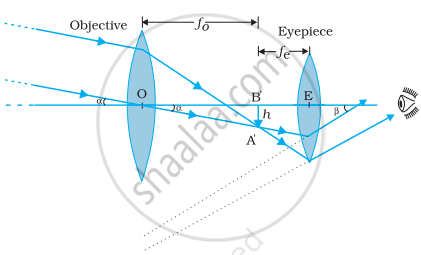
An object of height 4.25 mm is placed at a distance of 10 cm from a convex lens of power +5D. Find (i) the focal length of the lens, and (ii) the size of the image.
A symmetric double convex lens in cut in two equal parts by a plane perpendicular to the principal axis. If the power of the original lens was 4 D, the power a cut-lens will be
Complete the diagram to show the formation of the image of the object AB.
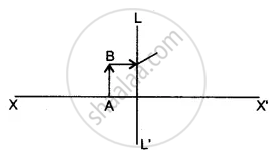
(i) Name the Lens LL’.
(ii) Where is the image of the object AB formed?
(iii) State three characteristics of the image.
If the lens is of focal length 25 cm. Calculate the power of the lens.
The focal length of a concave lens is 20 cm. The focal length of a convex lens is 25 cm. These two are placed in contact with each other. What is the power of the combination? Is it diverging, converging or undeviating in nature?
The power of a lens placed in a medium is given by:
A concave lens has:
