Advertisements
Advertisements
प्रश्न
According to Rayleigh’s scattering law, the amount of scattering of light is inversely proportional to the fourth power of its ______.
Advertisements
उत्तर
According to Rayleigh’s scattering law, the amount of scattering of light is inversely proportional to the fourth power of its wavelength.
APPEARS IN
संबंधित प्रश्न
A doctor has prescribed a corrective lens of power +1.5 D. Find the focal length of the lens. Is the prescribed lens diverging or converging?
Which type of lens has a positive power?
The focal length of a lens is +150 mm. What kind of lens is it and what is its power?
An object of height 4.25 mm is placed at a distance of 10 cm from a convex lens of power +5D. Find (i) the focal length of the lens, and (ii) the size of the image.
How is the power of a lens related to its focal length?
Express the power (with sign) of a concave lens of focal length 20 cm.
Which lens has more power a thick lens or a thin lens?
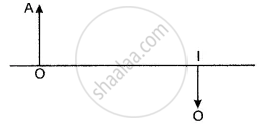
The following diagram shows the object O and the image I formed by a lens. Copy the diagram and on it mark the positions of the lens LL’ and focus (F). Name the lens.
Focal length : metre : : power of lens : _______
1 D is equivalent to:
