Advertisements
Advertisements
प्रश्न
A coin is places at the bottom of a beaker containing water (refractive index = 4/3) to a depth of 12 cm. By what height the coin appears to be raised when seen from vertically above?
Advertisements
उत्तर
Refractive index of the water, 𝛍w = 4/3
Real depth at which the coin is places = 12 cm
Shift in the image = ?
Shift = `"real depth"xx(1-1/µ)`
Shift= `12(1-3/4)`
R=12/4=3 cm
संबंधित प्रश्न
Write a short note on dispersion of light.
Observe the following figure and answer the questions given under it:

1) How many times does refraction take place in the above figure?
2) What happens to the ray of light when it passes from air to glass?
3) What happens to the ray of light when it passes from glass to air?
4) What are the rays AB and CD in the figure called?
5) Define refraction.
When light travels from a rarer to a denser medium, its speed ______.
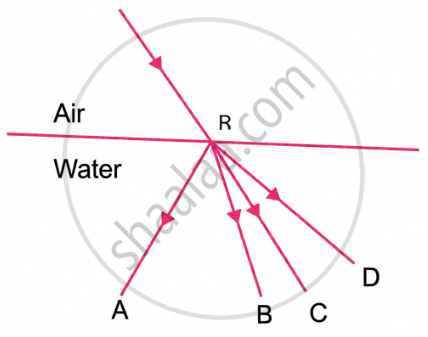
A ray of light passes from air to water. In fig., which of the ray A, B, C and D is the correct refracted ray?
Draw an í- `delta` graph for a mono chromatic raY through a glass prism of a plane and mark
(i) `delta` m, the angle of mínimum devíation
(íí) Any two values of i for which value of `delta` ís same.
Fig shows a lens as a combination of a glass block and two prisms.
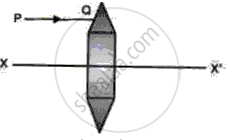
(i) Name the lens formed by the combination.
(ii) what is the XX' called?
(iii) Complete the ray diagram and show the path of the incident ray PQ after passing through the lens.
(iv) The final emergent ray will either meet XX' at a point or appear to come from a point on XX'. what is the point called?
The refractive index of air with respect to glass is defined: as gµa = sin i/sin r
If r = 90°, what is the corresponding angle i called?
In the diagram below, PQ is a ray of light incident on a rectangular glass block.

How are the angles ‘i’ and ‘e’ related to each other?
