हिंदी

When a Ray of Light Travels from Air to Glass Slab and Strikes the Surface Of Separation at 90°, Then It - Science and Technology 1

Advertisements
Advertisements

प्रश्न

When a ray of light travels from air to glass slab and strikes the surface of separation at 90°, then it …………….
(a) bends towards normal
(b) bends away from normal
(c) passes unbent
(d) passes in zigzag way

Advertisements

उत्तर

(c) passes unbent
In this case, the angle of incidence (i) is zero and so also the angle of refraction.

shaalaa.com
  क्या इस प्रश्न या उत्तर में कोई त्रुटि है?
2015-2016 (March)

APPEARS IN

संबंधित प्रश्न

What is a spectrum?


A student very cautiously traces the path of a ray through a glass slab for different values of the angle of incidence (∠i). He then measures the corresponding values of the angle of refraction (∠r) and the angle of emergence (∠e) for every value of the angle of incidence. On analysing these measurements of angles, his conclusion would be

(A) ∠i > ∠r  > ∠e

(B) ∠i = ∠e  > ∠r

(C) ∠i < ∠r  < ∠e

(D) ∠i = ∠e  < ∠r


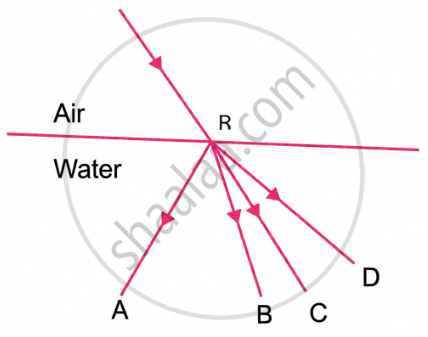
Draw the diagram given below and clearly show the path taken by the emergent ray.


A ray of light passes from glass into air. The angle of refraction will be:

(a) equal to the angle of incidence
(b) greater than the angle of incidence
(c) smaller than the angle of incidence
(d) 45° 


 How can you bend light away from the normal?


Draw diagrams to show the refraction of light from glass to air. In  diagram, label the incident ray, refracted ray, the angle of incidence (i) and the angle of refraction (r).


A ray of light of wavelength 6600 Å suffer refraction from air to glass. Taking \[\ce{_a\mu_g = \frac{3}{2}}\], find the wavelength of light in glass.


A ray of light is passing from a transparent medium 1 to another transparent medium 2 (i) Speed up (ii) slows down. In each case, state whether the refractive index of medium 2 is equal to, less than or greater than the refractive index of medium 1. 


Fill in the blanks to complete the following sentence 

When light travels from a denser to a rarer medium, its speed ………………. 


Fig 4.31 below shows a light ray of single colour incident normally on two prisms A and B. In each case draw the path of the ray of light as it enters and emerges out of the prism. Mark the angle wherever necessary. 


A postage stamp kept below a rectangular glass block of refractive index 1.5 when viewed from vertically above it, appears to be raised by 7.0 mm. Calculate the thickness of the glass slab.


The refractive index of glass is 1.5. From a point P inside a glass block, draw rays PA, PB and PC incident on the glass air surface at an angle of incidence 30°, 42° and 60° respectively.

  1. In the diagram show the approximate direction of these rays as they emerge out of the block.
  2. What is the angle of refraction for the ray PB? 

`("Take" sin 42° =2/3)` 


What do you mean by the term refraction?

For which colour of white light, is the refractive index of glass the most?

Define the absolute refractive index of a medium.

Fill in the blank to complete the following sentence:
When light travels from a rarer to a denser medium, it bends ...........


Show by a diagram, the refraction of two incident rays parallel to the principle axis passing through a concave lens by treating it as a combination of a glass block and two triangular glass prisms.

Fig. shows a ray of white light that passes through a prism and produces a spectrum.
(a) Name the phenomenon that is taking place.
(b) What colour would you see at X and Y?
(c) What radiation would you detect above X and below Y?


Light of a single colour is passed through a liquid having a piece of glass suspended in it. On changing the temperature of liquid, at a particular temperature, the glass piece is not seen.

Why is the light of a single colour used ?


A ray of light strikes the surface at a rectangular glass slab such that the angle of incidence is 45o.

In each case, draw diagram to show the path taken by the ray as it passes through the glass slab and emerges from it.


A total reflecting equilateral prism can be used to deviate a ray of light through:


Name the phenomenon responsible in the following case:

Apparent bending of a stick in water


Name the phenomenon responsible in the following case:

Twinkling of stars


Why does a fisherman aim at the tail of fish during spearfishing?


Does the depth of a tank of water appear to change or remain the same when viewed normally from above?


State the factors on which the angle of deviation depends.


State the relation between the refractive index μ and the velocity of light (vm) in that medium.


Define the term refractive index of a medium in terms of velocity of light.


Why does the sun appear bigger during sunset or sunrise?


How does the angle of deviation produced by a prism depend on the colour of light used? Which colour of white light is deviated (i) most, (ii) least, by a prism?


In the diagram below, PQ is a ray of light incident on a rectangular glass block.

Copy the diagram and complete the path of the ray of light through the glass block. In your diagram, mark the angle of incidence by letter ‘i’ and the angle of emergence by the letter ‘e’.


After a robbery, if a window has been broken, there will be tiny particles of glass. Some of these will be found at the scene of the crime and some may be caught in the thief’s clothing. If the police can prove that these particles are identical, they have a strong case.
A method of doing this is to suspend the particles of glass in a special liquid. Light of a single colour is thrown through the liquid and the particles viewed through a microscope. The temperature of the liquid is then slowly altered. This alters the speed of light through the liquid (i.e., it alters the refractive index). At one particular temperature, the particles of glass disappear. It this happens at the same temperature for both sets of glass particles, they probably came from the same broken pane of glass.
Complete and copy the diagram to show how light bends when it travels from the liquid to the glass and back to the liquid, If the light slows down in the glass.


Draw a diagram to show the refraction of a monochromatic light ray through an equilateral prism. On the diagram, label the incident, refracted, and emergent rays. It also indicates the angle of deviation by the letter δ.


Light passes through a rectangular glass slab and through a triangular glass prism. In what way does the direction of the two emergent beams differ and why?


The diagram shows the path of a ray of light through a rectangular glass block placed in a liquid of uniform density.

Show with the help of a ray diagram the path of the ray when incident ray normally falls on the first surface of the glass block and passes through the block and the liquid.


Calculate the velocity of light in a glass block of refractive index 1.5. (Velocity of light in air = 3 × 10m/s)


A coin placed at the bottom of a beaker appears to be raised by 4.0 cm. If the refractive index of water is 4/3, find the depth of the water in the beaker.


Share
Notifications

Englishहिंदीमराठी


      Forgot password?
Use app×