Advertisements
Advertisements
प्रश्न
Write a short note on dispersion of light.
Advertisements
उत्तर
Dispersion of light:-
The phenomenon of splitting of light into its component colours is called dispersion of light. When white light passes through a glass prism, it spreads out into a band of different colours which constitute the spectrum of light. The colours in the spectrum of white light are violet, indigo, blue, green, yellow, orange and red. Dispersion takes place because the refractive index of a material such as glass or water is different for different colours. It is maximum for violet colour and minimum for red colour. Hence, in the spectrum of white light obtained with a prism, violet light is deviated the most, while red light is deviated the least. The deviation of light corresponding to other colours lies in between these two colours.
APPEARS IN
संबंधित प्रश्न
In your laboratory you trace the path of light rays through a glass slab for different values of angle of incidence (∠i) and in each case measure the values of the corresponding angle of refraction (∠r) and angle of emergence (∠e). On the basis of your observations your correct conclusion is:
(a) ∠i is more than ∠r, but nearly equal to ∠e
(b) ∠i is less then ∠r, but nearly equal to ∠e
(c) ∠i is more than ∠e, but nearly equal to ∠r
(d) ∠i is less than ∠e, but nearly equal to ∠r
Draw the diagram given below and clearly show the path taken by the emergent ray.
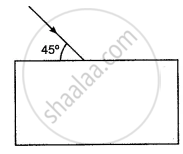
A monochromatic ray of light passes from air to glass. The wavelength of light in air is λ, the speed of light in air is c and in glass is V. If the absolute refractive index of glass is 1.5, write down
- the relationship between c and V,
- the wavelength of light in glass.
Name the colour of white light which is deviated the most on passing through a prism.
A ray of light enters a glass slab ABDC as shown in figure and strikes at the centre O of the circular part AC of the slab. The critical angle of glass is 42°. Complete the path of the ray till it emerges out from the slab. Mark the angles in the diagram wherever necessary.
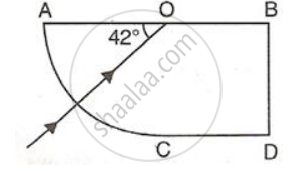
-
- the angle of refraction and
- the angle of deviation for the ray?
Make the correct for each of the following :
With reference to the fig, the refractive index of the glass block is
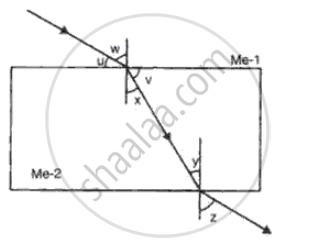
In an experiment of finding the refractive index of glass, if blue light is replaced by the red light, how will the refractive index of glass change? Give reason in support of your answer.
Draw a ray diagram showing the lateral displacement of a ray of light when it passes through a parallel sided glass slab.
Why is the colour red used as a sign of danger?
Does the depth of a tank of water appear to change or remain the same when viewed normally from above?
A fish swimming in a pond seems nearer than it really is. Explain.
A ray of light moves from a rare medium to a dense medium as shown in the diagram below. Write down the number of the ray which represents the partially reflected ray.

Light passes through a rectangular glass slab and through a triangular glass prism. In what way does the direction of the two emergent beams differ and why?
Trace a ray of light incident at 30° on a surface if travelling from glass to air. What is the angle of refraction in this case? (R.I. for glass = 3/2).
The refractive index of glass with respect to air is 1.5. What is the value of the refractive index of air with respect to glass?
A ray of light strikes the surface of a rectangular glass slab such that the angle of incidence in air is
- 0°,
- 45°.
In each case, draw a diagram to show the path taken by the ray as it passes through the glass slab and emerges from it.
