Advertisements
Advertisements
प्रश्न
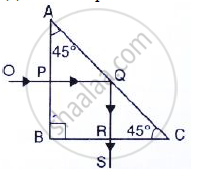
A ray of light OP passes through a right angles prism as shown in the adjacent diagram.
(a) State the angles of incidence at the faces AC and BC.
(b) Name the phenomenon which the ray suffers at the face AC.
Advertisements
उत्तर
(a) The angle of incidence at the face AC is 45° and angle of incidence at the face BC is 0°.
(b) The ray suffers total internal reflection at the face AC.
संबंधित प्रश्न
When a lighted candle is held in front of a thick plane glass mirror, several images can be seen, but the second image is the brightest, give reason.
A coin is places at the bottom of a beaker containing water (refractive index = 4/3) to a depth of 12 cm. By what height the coin appears to be raised when seen from vertically above?
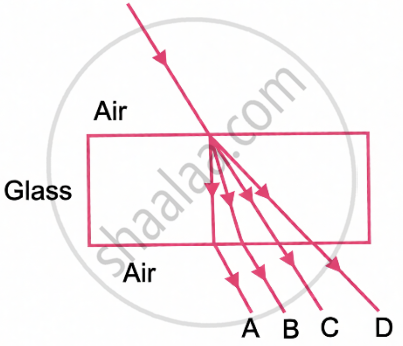
In the fig. name the ray which represents the correct path of light while passing through a glass block.
In an experiment of finding the refractive index of glass, if blue light is replaced by the red light, how will the refractive index of glass change? Give reason in support of your answer.
Which colour of light travels fastest in any medium except air?
The figure shows two prisms A and B. A monochromatic ray of light PO is incident at the face of the prism A. Complete the diagram to show the path of the ray till it emerges out of the prism B.

Trace a ray of light incident at 30° on a surface if travelling from air to glass. What is the angle of refraction in this case? (R.I. for glass = 3/2).
Observe the figure and name the ray AB, ray CD, ray GH.

