Advertisements
Advertisements
प्रश्न
Advertisements
उत्तर
APPEARS IN
संबंधित प्रश्न
Name one factor that affects the lateral displacement of light as it passes through a rectangular glass slab.
Name a prism required for obtaining a spectrum of Ultraviolet light.
With the help of diagram of the principal section of a prism, indicate its refracting surfaces, refracting edge and base.
The refractive index of glass is 1.5. From a point P inside a glass block, draw rays PA, PB and PC incident on the glass air surface at an angle of incidence 30°, 42° and 60° respectively.
- In the diagram show the approximate direction of these rays as they emerge out of the block.
- What is the angle of refraction for the ray PB?
`("Take" sin 42° =2/3)`
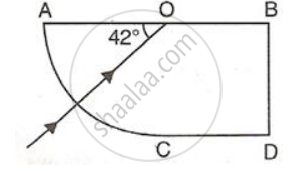
A ray of light enters a glass slab ABDC as shown in figure and strikes at the centre O of the circular part AC of the slab. The critical angle of glass is 42°. Complete the path of the ray till it emerges out from the slab. Mark the angles in the diagram wherever necessary.
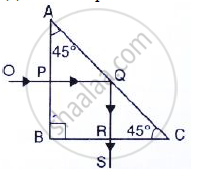
A ray of light OP passes through a right angles prism as shown in the adjacent diagram.
(a) State the angles of incidence at the faces AC and BC.
(b) Name the phenomenon which the ray suffers at the face AC.
-
- the angle of refraction and
- the angle of deviation for the ray?
Fill in the blank to complete the following sentence:
When light travels from a rarer to a denser medium, it bends ...........
A fish swimming in a pond seems nearer than it really is. Explain.
