Advertisements
Advertisements
प्रश्न
In the adjacent diagram, AO is a ray of light incident on a rectangular glass slab.

- Complete the path of the ray till it emerges out of the slab.
- In the diagram, mark the angle of incidence (i) and the angle of refraction (r) at the first interface. How is the refractive index of glass related to the angles i and r?
- Mark angles of emergence by the letter e. How are the angles i and e related?
- Which two rays are parallel to each other? Name them.
- Indicate in the diagram the lateral displacement between the emergent ray and the incident ray. State one factor that affects the lateral displacement.
Advertisements
उत्तर
- The ray's path through the glass slab is complete.
- `""^amu_g = "R.I glass" = sin i/sin r`

- Angle of emergence ∠e is marked ∠i = ∠e
- Emergent ray BD and incident ray AO are parallel.
- DE shows the lateral displacement.
The following factors affect lateral displacement:
- The angle of incidence.
- The glass slab's (or medium's) thickness.
- Refractive index of glass.
APPEARS IN
संबंधित प्रश्न
Which of the above wavelengths has a higher frequency?
How is the reflection of light ray from a plane mirror different from the refraction of light ray as it enters a block of glass?
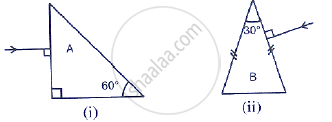
Fig 4.31 below shows a light ray of single colour incident normally on two prisms A and B. In each case draw the path of the ray of light as it enters and emerges out of the prism. Mark the angle wherever necessary.
What is meant by the statement the critical angle for diamond is 24°?
The critical angle for glass-air is 45° for the light of yellow colour. State whether it will be less than, equal to, or more than 45° for (i) ref light, (ii) blue light?
A ray of light falls normally on the surface of a transparent glass slab. Draw a ray diagram to show its path and also mark angle of incidence and angle of emergence.
A fish swimming in a pond seems nearer than it really is. Explain.
A ray of monochromatic light is incident from the air on a glass slab:
(i) Draw a labelled ray diagram showing the change in the path of the ray till it emerges from the glass slab.
(ii) Name the two rays that are parallel to each other.
(iii) Mark the lateral displacement in your diagram.
Draw the ray diagram of a glass slab having medium A and B for the velocity of light ray VA and VB respectively and define Snell's law.
- If VB = 1.5 VA, then which medium is denser?
- What is the refractive index of A with respect to B?
- What is the refractive index of B with respect to A?
Observe the figure and name the ray AB, ray CD, ray GH.

