Advertisements
Advertisements
प्रश्न
What is the total reflecting prism?
Advertisements
उत्तर
A total reflecting prism is a right-angled prism made of glass with other two angles each equal to 45°.
संबंधित प्रश्न
Why do we get a spectrum of seven colors when white light is dispersed by a prism?
With the help of diagram of the principal section of a prism, indicate its refracting surfaces, refracting edge and base.
Fig shows a lens as a combination of a glass block and two prisms.
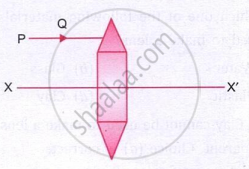
- Name the lens formed by the combination.
- What is the line XX' called?
- Complete the path of the incident ray PQ after passing through the lens.
- The final emergent ray either meets XX' at a point or appears to come from a point on XX'. Label it as F, What is this point called?
In the diagram alongside a ray of light, PQ is incident normally on one face AB of an equilateral glass prism. What is the angle of incidence at the faces AB and AC?

Complete the ray diagram showing its emergence into the air after passing through the prism.

Explain with the help of a diagram of how fish is able to see the objects above it.
A ray of light PQ is incident normally on the hypotenuse of a right-angled prism ABC as shown in the diagram given below:

(i) Copy the diagram and complete the path of the ray PQ till it emerges from the prism.
(ii) What is the value of the angle of deviation of the ray?
(iii) Name an instrument where this action of the prism is used.
A glass block is having refractive index 3/2, the light ray is incident at an angle 45°. Find the sine of the angle of, refraction inside the glass block.
Observe the figure and name the ray AB, ray CD, ray GH.

A ray of light strikes the surface of a rectangular glass slab such that the angle of incidence in air is
- 0°,
- 45°.
In each case, draw a diagram to show the path taken by the ray as it passes through the glass slab and emerges from it.
