Advertisements
Advertisements
Question
Write the relation between the angle of incidence and the angle of refraction for a medium.
Advertisements
Solution
The relationship between the angles of incidence and refraction is given by Snell's law.
According to this law, the ratio of the sines of the angles of incidence and refraction is constant for a given pair of media.
`"(Sineof angle of incidence (i))"/"(Sine of angle of refraction (r)"="constant (n)"`
This constant is known as refractive index.
RELATED QUESTIONS
When rays of light are incident on a glass slab then the incident ray and emergent ray are _________ each other.
- perpendicular
- parallel
- opposite
- concurrent
A student very cautiously traces the path of a ray through a glass slab for different values of the angle of incidence (∠i). He then measures the corresponding values of the angle of refraction (∠r) and the angle of emergence (∠e) for every value of the angle of incidence. On analysing these measurements of angles, his conclusion would be
(A) ∠i > ∠r > ∠e
(B) ∠i = ∠e > ∠r
(C) ∠i < ∠r < ∠e
(D) ∠i = ∠e < ∠r
State the dependence of angle of deviation on the wavelength of light
Name one factor that affects the lateral displacement of light as it passes through a rectangular glass slab.
The speed of light in glass is 2 × 10⁵ km/s. What is the refractive index of glass?
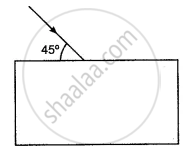
Draw the diagram given below and clearly show the path taken by the emergent ray.
Four students A, B, C and D traced the paths of incident ray and the emergent ray by fixing pins P and Q for incident ray and pins R and S for emergent ray for a ray of light passing through a glass slab.

The correct emergent ray was traced by the student:
(1) A
(2) B
(3) C
(4) D
Complete the ray diagram showing its emergence into the air after passing through the prism.

A ray of light PQ is incident normally on the hypotenuse of a right-angled prism ABC as shown in the diagram given below:

(i) Copy the diagram and complete the path of the ray PQ till it emerges from the prism.
(ii) What is the value of the angle of deviation of the ray?
(iii) Name an instrument where this action of the prism is used.
