Advertisements
Advertisements
Question
Why upper surface of water contained in a beaker and above eye level appears silvery?
Advertisements
Solution
Critical angle for water is 49°. The rays of light entering the water from below, suffer refraction. If these rays strike the water-air surface at an angle which is greater than 48°, they get totally internally reflected. These rays on emerging out of the water, appear to come from the upper surface of the water, which in turn appears silvery.
APPEARS IN
RELATED QUESTIONS
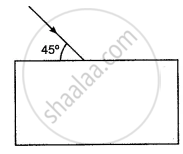
Draw the diagram given below and clearly show the path taken by the emergent ray.
Which colour of light travels fastest in any medium except air?
How is the refractive index of a medium related to the speed of light in it?
How does the speed of light change when it passes from glass to water?
Four students showed the following traces of the path of a ray of light passing through a rectangular glass slab.

The trace most likely to be correct is that of student
(A) I
(B) II
(C) III
(D) IV
(i) What is the relation between the refractive index of water with respect to air `("_aμ_\text(w))` and the refractive index of air with respect to water `("_\text(w)μ_ a)` .
(ii) If the refractive index of water with respect to air `("_aμ_\text(w))` is`5/3`. Calculate the refractive index of air with respect to water `("_\text(w)μ_ a)` .
Does the depth of a tank of water appear to change or remain the same when viewed normally from above?
Light passes through a rectangular glass slab and through a triangular glass prism. In what way does the direction of the two emergent beams differ and why?
