Advertisements
Advertisements
Question
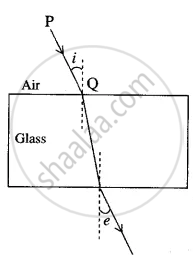
In the diagram below, PQ is a ray of light incident on a rectangular glass block.

Copy the diagram and complete the path of the ray of light through the glass block. In your diagram, mark the angle of incidence by letter ‘i’ and the angle of emergence by the letter ‘e’.
Advertisements
Solution
RELATED QUESTIONS
A student traces the path of a ray of light through a rectangular glass slab for the different values of angle of incidence. He observes all possible precautions at each step of the experiment. At the end of the experiment, on analyzing the measurements, which of the following conclusions is he likely to draw?
(A) ∠i = ∠e < ∠r
(B) ∠i < ∠e < ∠r
(C) ∠i > ∠e > ∠r
(D) ∠i = ∠e > ∠r
A student traces the path of a ray of light passing through a rectangular glass slab and marks the angle of incidence i, angle of refraction r and angle of emergence e, as shown.
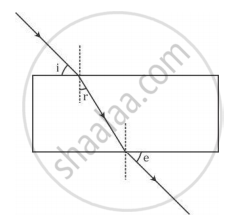
The correctly marked angle(s) is/are
(A) ∠ i only
(B) ∠ e only
(C) ∠ r only
(D) ∠ i and ∠ e
If the speed of light in vacuum is 3 × 10⁸ ms−1, find the speed of light in a medium of absolute refractive index 1.5.
Select from the following the best set-up for tracing the path of a ray of light through a rectangular glass slab:

(A) I
(B) II
(C) III
(D) IV
Four students showed the following traces of the path of a ray of light passing through a rectangular glass slab.

The trace most likely to be correct is that of student
(A) I
(B) II
(C) III
(D) IV
Fig shows a lens as a combination of a glass block and two prisms.
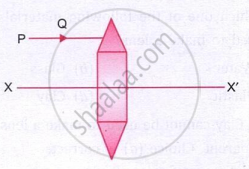
- Name the lens formed by the combination.
- What is the line XX' called?
- Complete the path of the incident ray PQ after passing through the lens.
- The final emergent ray either meets XX' at a point or appears to come from a point on XX'. Label it as F, What is this point called?
How does the deviation produced by a prism depend on the wavelength of incident light?
How does the angle of deviation produced by a prism depend on the colour of light used? Which colour of white light is deviated (i) most, (ii) least, by a prism?
Complete the ray diagram showing its emergence into the air after passing through the prism.

Draw the ray diagram of a glass slab having medium A and B for the velocity of light ray VA and VB respectively and define Snell's law.
- If VB = 1.5 VA, then which medium is denser?
- What is the refractive index of A with respect to B?
- What is the refractive index of B with respect to A?
