Advertisements
Advertisements
Question
Define the term refractive index of a medium. What do you understand by the statement 'the refractive index of glass is 1.5 for white light'?
Advertisements
Solution
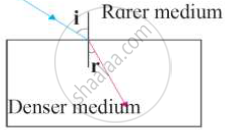
When light travels from one medium (air) to another medium (glass), it bends towards the normal. The extent of bending of light depends upon the speed of light (v2) in the second medium, compared to the speed of light (v1) in the first medium. The refractive index of the second medium w.r.t. the first medium (n21) is given by
n21 = Speed of light (v1) in first medium / speed of light (v2) in second medium
The refractive index of glass is typically around 1.5, meaning that light in glass travels at
c / 1.5 = 200,000 km/s. A low value of refractive index also indicates a large critical angle at the glass-air interface.
APPEARS IN
RELATED QUESTIONS
State the dependence of angle of deviation on the refractive index of the material of the prism.
Draw the diagram of refraction of light in the glass slab
When a ray of light from air enters a denser medium, it ______.
“A ray of light incident on a rectangular glass slab immersed in any medium emerges parallel to itself.” Draw labelled ray diagram to justify the statement.
Observe the figure and write accurate conclusion regarding refraction of light.
What is the correct reason for blinking / flickering of stars? Explain it.
a) The blasts in the stars.
b) Absorption of star light by the atmosphere.
c) Motion of the stars.
d) Changing refractive index of gases in the atmosphere.
Fill in the blank to complete the following sentence:
When light travels from a rarer to a denser medium, it bends ...........
A ray of light is incident at an angle of 45° on one face of a rectangular glass slab of thickness 10 cm and refractive index 3/2. Calculate the lateral shift produced ______.
