Advertisements
Advertisements
Question
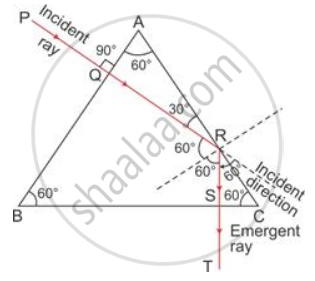
A total reflecting equilateral prism can be used to deviate a ray of light through:
Options
30°
60°
75°
90°
Advertisements
Solution
60°
Hint:
RELATED QUESTIONS
After tracing the path of a ray of light passing through a rectangular glass slab for four different values of the angle of incidence, a student reported his observations in tabular form as given below:
| S.No | ∠ i | ∠ r | ∠ e |
| I | 30° | 19° | 29° |
| II | 40° | 28° | 40° |
| III | 50° | 36° | 50° |
| IV | 60° | 40° | 59° |
The best observation is
(A) I
(B) II
(C) III
(D) IV
How is the refractive index of a medium related to the speed of light in it?
How does the angle of deviation produced by a prism change with increase in the angle of incidence. Draw a curve showing the variation in the angle of deviation with the angle of incidence at a prism surface.
Light of a single colour is passed through a liquid having a piece of glass suspended in it. On changing the temperature of liquid, at a particular temperature, the glass piece is not seen.
Why is the light of a single colour used ?
A ray of light strikes the surface at a rectangular glass slab such that the angle of incidence is 45o.
In each case, draw diagram to show the path taken by the ray as it passes through the glass slab and emerges from it.
A ray of monochromatic light is incident from air into a glass slab. Draw a labelled ray diagram indicating the change in its path till it emerges out of the slab. In the diagram, mark the angle of incidence (i) and the angle of refraction (r) at the first interface. How is the refractive index of glass related to the angles i and r?
In the diagram alongside a ray of light, PQ is incident normally on one face AB of an equilateral glass prism. What is the angle of incidence at the faces AB and AC?

Observe the figure and name the ray AB, ray CD, ray GH.

