Advertisements
Advertisements
प्रश्न
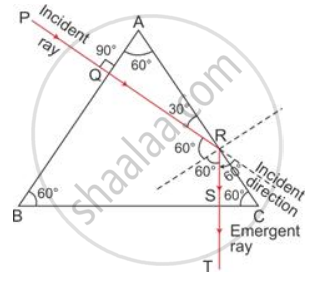
A total reflecting equilateral prism can be used to deviate a ray of light through:
पर्याय
30°
60°
75°
90°
Advertisements
उत्तर
60°
Hint:
संबंधित प्रश्न
How is the reflection of light ray from a plane mirror different from the refraction of light ray as it enters a block of glass?
How must light travel out of a substance if it is not going to be refracted?
For which colour of white light, is the refractive index of a transparent medium the most?
In the adjacent diagram, AO is a ray of light incident on a rectangular glass slab.

- Complete the path of the ray till it emerges out of the slab.
- In the diagram, mark the angle of incidence (i) and the angle of refraction (r) at the first interface. How is the refractive index of glass related to the angles i and r?
- Mark angles of emergence by the letter e. How are the angles i and e related?
- Which two rays are parallel to each other? Name them.
- Indicate in the diagram the lateral displacement between the emergent ray and the incident ray. State one factor that affects the lateral displacement.
With the help of diagram of the principal section of a prism, indicate its refracting surfaces, refracting edge and base.
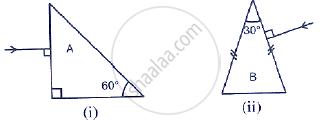
Fig 4.31 below shows a light ray of single colour incident normally on two prisms A and B. In each case draw the path of the ray of light as it enters and emerges out of the prism. Mark the angle wherever necessary.
What is meant by the statement the critical angle for diamond is 24°?
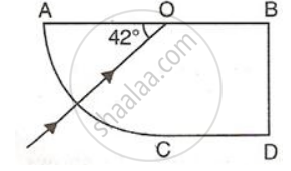
A ray of light enters a glass slab ABDC as shown in figure and strikes at the centre O of the circular part AC of the slab. The critical angle of glass is 42°. Complete the path of the ray till it emerges out from the slab. Mark the angles in the diagram wherever necessary.
What do you understand by the deviation produced by a prism?
Observe the figure and name the ray AB, ray CD, ray GH.

