Advertisements
Advertisements
Question
In what condition a prism is said to be in the position of minimum deviation? What is the direction of the refracted ray inside the prism in this condition?
Advertisements
Solution
A prism is said to be in the position of minimum deviation when the angle of incidence of the light ray at the first prism surface is equal to the angle of emergence at the second surface of the prism.
In this condition, the refracted ray inside the prism is parallel to the base of the prism (if the prism is equilateral).
RELATED QUESTIONS
If the speed of light in vacuum is 3 × 10⁸ ms−1, find the speed of light in a medium of absolute refractive index 1.5.
A ray of light passes from water to air. How does the speed of light change?
Name a prism required for obtaining a spectrum of Ultraviolet light.
In the adjacent diagram, AO is a ray of light incident on a rectangular glass slab.

- Complete the path of the ray till it emerges out of the slab.
- In the diagram, mark the angle of incidence (i) and the angle of refraction (r) at the first interface. How is the refractive index of glass related to the angles i and r?
- Mark angles of emergence by the letter e. How are the angles i and e related?
- Which two rays are parallel to each other? Name them.
- Indicate in the diagram the lateral displacement between the emergent ray and the incident ray. State one factor that affects the lateral displacement.
An object is viewed through a glass prism with its vertex pointing upwards. It appears to be displaced upward. Explain the reason.
Select from the following the best experimental set-up for tracing the path of a ray of light through a glass slab: (A) I
(A) I
(B) II
(C) III
(D) IV
Which of the following is the best experimental set-up out of the four shown for tracing the path of a ray of light passing through a rectangular glass slab ?
A student traces the path of a ray of white light through a rectangular glass slab and marks, the angles of incidence (∠i) , refraction (∠r) and emergence (∠e) as shown. Which angle or angles has he not marked correctly?

(A) ∠i only
(B) ∠i and ∠r
(C) ∠i and ∠e
(D) ∠r and ∠e
Fig shows a lens as a combination of a glass block and two prisms.
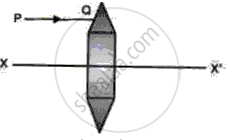
(i) Name the lens formed by the combination.
(ii) what is the XX' called?
(iii) Complete the ray diagram and show the path of the incident ray PQ after passing through the lens.
(iv) The final emergent ray will either meet XX' at a point or appear to come from a point on XX'. what is the point called?
What is the total reflecting prism?
