Advertisements
Advertisements
प्रश्न
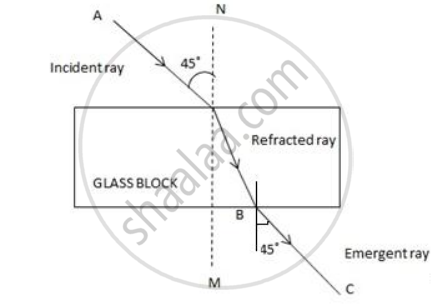
A ray of light strikes the surface at a rectangular glass slab such that the angle of incidence is 45o.
In each case, draw diagram to show the path taken by the ray as it passes through the glass slab and emerges from it.
Advertisements
उत्तर
When angle of incidence is 45o.
संबंधित प्रश्न
When a ray of light travels from air to glass slab and strikes the surface of separation at 90°, then it …………….
(a) bends towards normal
(b) bends away from normal
(c) passes unbent
(d) passes in zigzag way
For which colour of white light, is the refractive index of a transparent medium the most?
What is meant by the statement the critical angle for diamond is 24°?
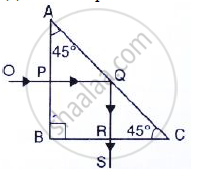
A ray of light OP passes through a right angles prism as shown in the adjacent diagram.
(a) State the angles of incidence at the faces AC and BC.
(b) Name the phenomenon which the ray suffers at the face AC.
Name the material for which the refractive index is found to be maximum.
Define the term refractive index of a medium in terms of velocity of light.
Name two instruments of the total refracting prism in which is used.
Two parallel rays of Red and Violet travelling through the air, meet the air-glass boundary as shown in the above figure. Will their paths inside the glass be parallel? Give a reason for your answer.

Light passes through a rectangular glass slab and through a triangular glass prism. In what way does the direction of the two emergent beams differ and why?
The diagram shows the path of a ray of light through a rectangular glass block placed in a liquid of uniform density.

Show with the help of a ray diagram the path of the ray when incident ray normally falls on the first surface of the glass block and passes through the block and the liquid.
