Advertisements
Advertisements
प्रश्न
Two parallel rays of Red and Violet travelling through the air, meet the air-glass boundary as shown in the above figure. Will their paths inside the glass be parallel? Give a reason for your answer.

Advertisements
उत्तर
No.
Reason: Deviation suffered by each ray will be different because the refractive index is different for different colours of light.
संबंधित प्रश्न
Explain the term absolute refractive index of a medium and write an expression to relate it with the speed of light in vacuum.
Name the colour of white light which is deviated the most on passing through a prism.
An object is viewed through a glass prism with its vertex pointing upwards. It appears to be displaced upward. Explain the reason.
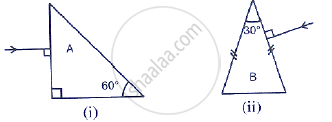
Fig 4.31 below shows a light ray of single colour incident normally on two prisms A and B. In each case draw the path of the ray of light as it enters and emerges out of the prism. Mark the angle wherever necessary.
The refractive index of air with respect to glass is expressed as `""_g μ_a=sin i /sin r`.
- Write down a similar expression for aμg in terms of the angles i and r.
- If angle r = 90°, what is the corresponding angle i called?
- What is the physical significance of the angle i in part (b)?
Four students A, B, C and D traced the paths of incident ray and the emergent ray by fixing pins P and Q for incident ray and pins R and S for emergent ray for a ray of light passing through a glass slab.

The correct emergent ray was traced by the student:
(1) A
(2) B
(3) C
(4) D
Draw a diagram to show the splitting of white light into its constituent colours.
Complete the ray diagram showing its emergence into the air after passing through the prism.

