Advertisements
Advertisements
प्रश्न
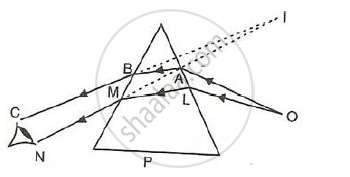
An object is viewed through a glass prism with its vertex pointing upwards. It appears to be displaced upward. Explain the reason.
Advertisements
उत्तर
Let two rays OA and OL from a source O are incident on the prism. They are refracted along AB and LM from first face of the prism. These two rays again refract from the second face of the prism emerge out along BC and MN respectively such that they appear to come from I.
संबंधित प्रश्न
A student traces the path of a ray of light through a rectangular glass slab for the different values of angle of incidence. He observes all possible precautions at each step of the experiment. At the end of the experiment, on analyzing the measurements, which of the following conclusions is he likely to draw?
(A) ∠i = ∠e < ∠r
(B) ∠i < ∠e < ∠r
(C) ∠i > ∠e > ∠r
(D) ∠i = ∠e > ∠r
Select from the following the best experimental setup for tracing the path of a ray of light passing through a rectangular glass slab.
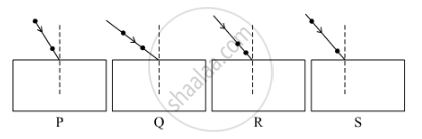
(a) P
(b) Q
(c) R
(d) S
Why is the ratio of the velocities of light of wavelengths 4000Å and 8000Å in vacuum 1: 1?
How is the reflection of light ray from a plane mirror different from the refraction of light ray as it enters a block of glass?
Draw diagrams to show the refraction of light from
- air to glass, and
- glass to air. In each diagram, label the incident ray, refracted ray, the angle of incidence
- and the angle of refraction (r).
Draw diagrams to show the refraction of light from glass to air. In diagram, label the incident ray, refracted ray, the angle of incidence (i) and the angle of refraction (r).
A ray of light moves from a rare medium to a dense medium as shown in the diagram below. Write down the number of the ray which represents the partially reflected ray.

The figure shows two prisms A and B. A monochromatic ray of light PO is incident at the face of the prism A. Complete the diagram to show the path of the ray till it emerges out of the prism B.

Explain with the help of a diagram of how fish is able to see the objects above it.
Observe the figure and name the ray AB, ray CD, ray GH.

